Cannes, Freedom and the Power of the Image
Cannes, Freedom and the Power of the Image
Cannes, Freedom and the Power of the Image
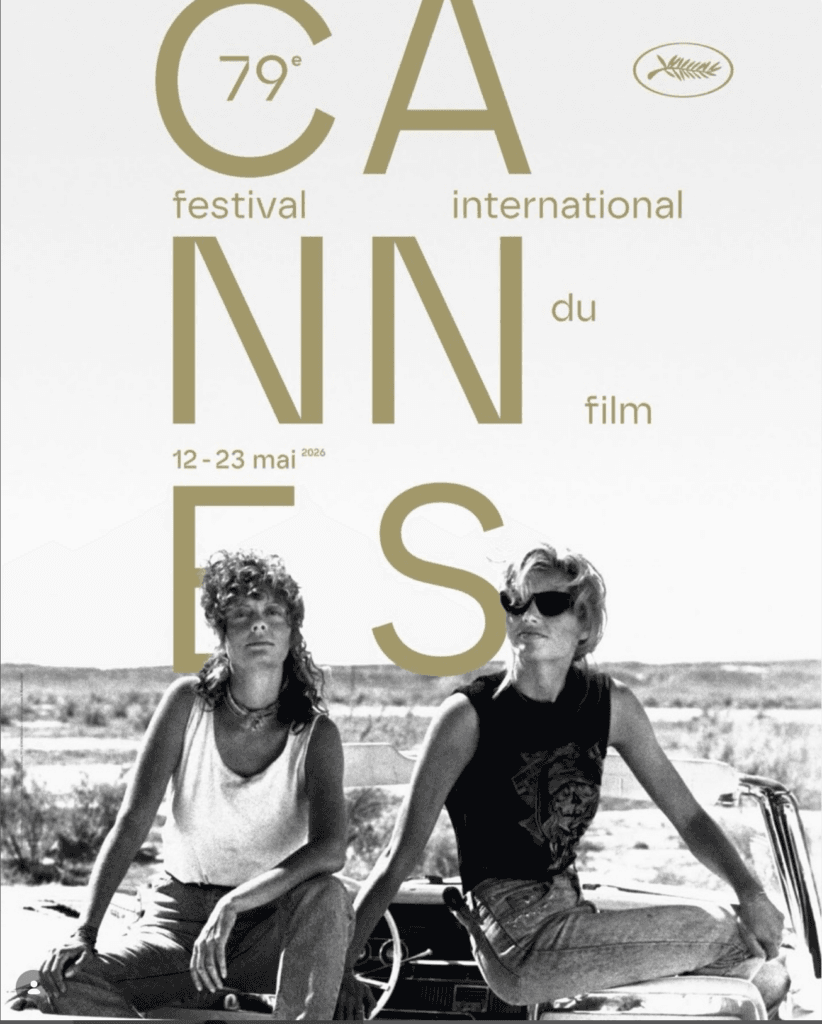
In Cannes, an image is never just an image. It can become a memory, a manifesto, a symbol, a mirror of its time. For its 79th edition, taking place from May 12 to May 23, 2026, the Festival de Cannes chose to place Thelma & Louise at the heart of its official poster, thirty-five years after Ridley Scott’s film premiered in Cannes on May 20, 1991. The image, photographed by Roland Neveu on the set of the film, brings back Geena Davis and Susan Sarandon as two unforgettable figures of cinema, friendship and freedom.
There is something deeply powerful in this choice. Cannes could have selected glamour, red carpets, jewels, or the eternal sparkle of cinema. Instead, the Festival chose a black-and-white image of two women who, in the collective imagination, still represent courage, rebellion and the right to escape a life that no longer fits. It is not only a tribute to a film. It is a tribute to the power of an image to survive time.
Thelma & Louise is more than a road movie. It is a visual declaration of independence. When the film was released, its two heroines quickly became cultural icons. They were not portrayed as perfect women, nor as untouchable symbols. They were fragile, funny, wounded, impulsive and alive. Their strength came from their humanity. This is perhaps why their image still resonates today. They do not simply belong to cinema history; they belong to the emotional memory of generations.
The official Cannes poster reminds us that photography has the rare ability to freeze not only a moment, but also an idea. A still image can carry the movement of an entire story. It can suggest what happened before and what may come after. It can hold silence, tension, desire and destiny. In one frame, we understand the bond between two women, the vastness of the road, the danger of freedom, and the beauty of refusing to disappear.
This is the great mystery of powerful images. They do not explain everything. They leave space for us. They invite us to enter, to feel, to remember, to project. The most unforgettable photographs are often not the most perfect ones. They are the images that contain a truth. A look, a gesture, a shadow, a horizon. Something happens inside them that cannot be fully described.
Cannes has always understood this relationship between cinema and photography. Before a film is seen, it is often discovered through an image: a poster, a still, a face, a silhouette, a fragment. These images travel faster than words. They create desire. They shape memory. They become icons. Sometimes, one photograph can define an entire film. Sometimes, one image can define an era.
The choice of Thelma & Louise also arrives at a moment when questions of freedom, identity and representation remain essential. What does it mean to be free? Who has the right to tell their own story? How can an image challenge the way we see women, bodies, landscapes, power and vulnerability? The answer is not always found in speeches. Sometimes, it is found in a photograph.
The image of Thelma and Louise continues to speak because it carries both beauty and resistance. It is elegant without being decorative. It is cinematic without being distant. It has the energy of movement, even in stillness. It reminds us that freedom is not always soft or comfortable. Sometimes freedom is a rupture. Sometimes it is a decision. Sometimes it is the moment when a person finally chooses not to return to the place assigned to them.
For photographers, this poster is also a lesson. A strong image does not need to shout. It needs to hold something essential. It must create an emotional impact before it becomes intellectual. The viewer must feel before they analyze. That is why the greatest photographs often stay with us like memories we never lived. They become part of our inner landscape.
In the age of endless images, this is more important than ever. Every day, thousands of photographs pass before our eyes. Most disappear immediately. But some remain. They remain because they contain intention. They remain because they reveal a vision. They remain because they do not simply show the world; they transform the way we look at it.
This is where photography becomes art. Not when it is perfect, but when it is necessary. Not when it follows trends, but when it carries emotion, tension, mystery or truth. A photograph can be beautiful, but beauty alone is not always enough. The most powerful images are those that open a door inside the viewer.
Cannes, with this poster, reminds us that the image is still one of the strongest languages of our time. It crosses borders. It speaks before translation. It can be political, poetic, intimate and universal at once. It can tell a story without a single line of dialogue. It can give visibility to those who were unseen. It can turn a face into a symbol and a moment into history.
Thelma and Louise return to Cannes not as nostalgia, but as presence. Their image is not frozen in the past. It looks back at us. It questions us. It asks what freedom means today, and what kind of images we want to create for tomorrow.
Perhaps this is why Cannes remains such a powerful stage for visual culture. Beyond the films, beyond the stars, beyond the ceremony, it is a place where images are born, celebrated and remembered. It is a place where cinema becomes photography, and photography becomes myth.
In the end, the power of an image lies in its ability to outlive the moment that created it. Thirty-five years later, Thelma & Louise still carries the same fire. It still speaks of friendship, escape, courage and self-determination. It still reminds us that an image can be more than a document. It can be a declaration.
And in Cannes, where every frame can become legend, that declaration feels more alive than ever.
Crédit : Photo Roland Neveu, sur le plateau de Thelma et Louise — Ridley Scott, 1991 — © MGM Studios / Création graphique © Hartland Villa.
Comments are closed.