
Sony RX10 V Analysis: Can One Camera Replace an Entire Bag of Lenses?
Sony RX10 V Analysis: Can One Camera Replace an Entire Bag of Lenses?
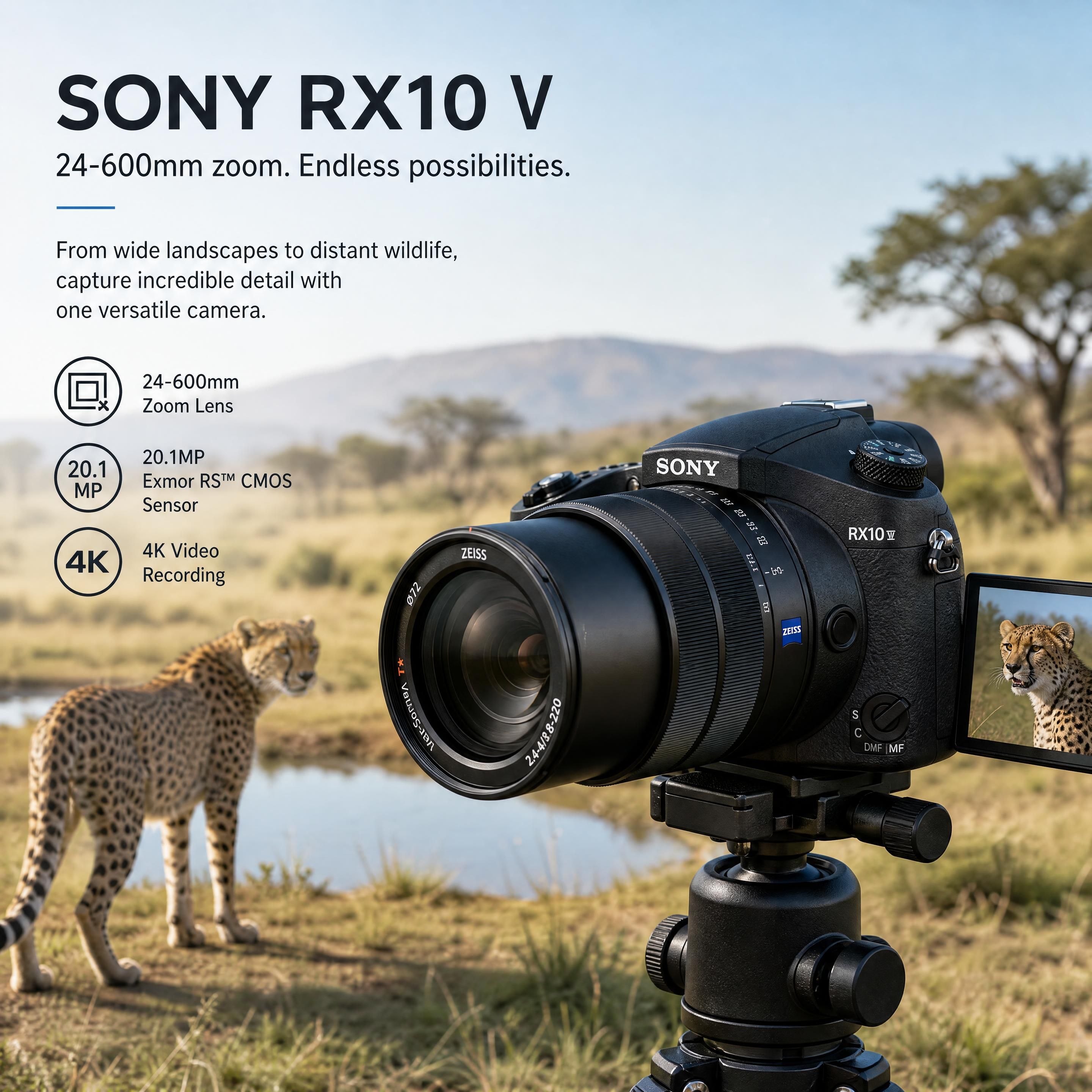
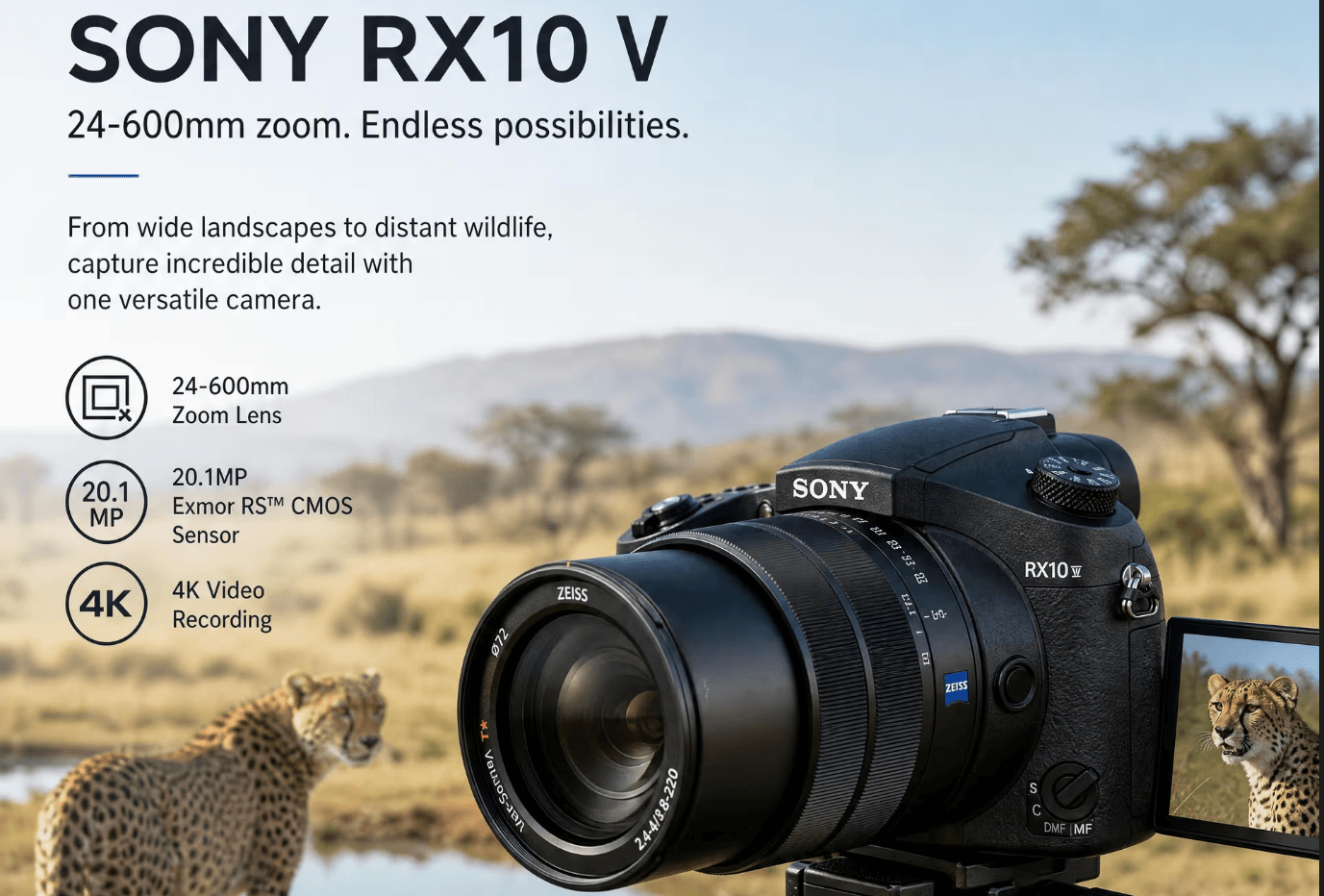
A 24–600mm equivalent zoom, a fast f/2.4–4 aperture, subject-recognition autofocus, 30 frames per second shooting and a compact all-in-one design: on paper, the Sony RX10 V sounds like the camera many travel, wildlife and sports photographers have been waiting for.
Announced on July 8, 2026, with pre-orders beginning on July 9, 2026, the RX10 V arrives nine years after the RX10 IV. Sony has kept the camera’s defining feature—the integrated ZEISS 24–600mm lens—but paired it with a newer stacked 1-inch sensor, BIONZ XR processing and a more advanced autofocus system.
The main question is not whether the RX10 V is versatile. Its specifications clearly indicate that it is. The more important question is whether it can genuinely replace a mirrorless camera with several lenses, especially at a price expected to be around €2,500.
Based on Sony’s official specifications and the first independent reviews, the answer appears to be cautious but positive: for travel, wildlife and outdoor sports, the RX10 V could replace a large amount of equipment. For professional low-light work or maximum image quality, it is unlikely to fully replace a larger-sensor interchangeable-lens camera.
Table of Contents
- Sony RX10 V: Key Specifications
- The Sony RX10 V 24–600mm Zoom: How Good Is It?
- Autofocus and Subject Tracking
- Low-Light Performance and the 1-Inch Sensor
- Weight and Size Compared with a Mirrorless Kit
- Sony RX10 V vs RX10 IV
- Who Should Buy the Sony RX10 V?
- Frequently Asked Questions
- Key Figures
- Conclusion
Sony RX10 V: Key Specifications
| Feature | Sony RX10 V |
|---|---|
| Sensor | 20.1MP 1.0-type stacked CMOS |
| Lens | ZEISS Vario-Sonnar T* 24–600mm equivalent |
| Maximum aperture | f/2.4–4.0 |
| Optical zoom | 25x |
| Image stabilization | Optical SteadyShot |
| Continuous shooting | Up to 30 fps with AF/AE tracking |
| Autofocus | Real-time Recognition AF with subject tracking |
| Processor | BIONZ XR |
| Video | Up to 4K/120p, with 10-bit recording support |
| Battery | NP-FZ100 |
| Claimed battery life | Approximately 570–630 still images, depending on display used |
| Price | Approximately €2,500 in Europe; $2,299.99 suggested retail price in the United States |
Sony’s official announcement describes the RX10 V as a 25x superzoom camera with a 24–600mm lens, AI-powered subject recognition and blackout-free continuous shooting of up to 30 frames per second. The camera also uses Sony’s larger NP-FZ100 battery, which is a significant change from the RX10 IV’s NP-FW50 system.
The complete announcement and specifications are available through Sony Alpha Universe. Current United States pricing and pre-order information can also be checked through Sony Electronics.
The Sony RX10 V 24–600mm Zoom: How Good Is It?
The RX10 V’s greatest advantage is also its most difficult engineering challenge: placing a 24–600mm equivalent lens into a fixed-lens camera without making unacceptable compromises.
The range should be useful for a broad variety of subjects. At 24mm, the camera is suitable for:
- Landscapes and architecture
- Group portraits
- Travel photography
- Interior scenes
- Environmental portraits
At the long end, 600mm can be useful for:
- Birds and distant wildlife
- Outdoor sports
- Aircraft
- Stage performances
- Details on buildings and landscapes
The maximum aperture is not constant—the lens changes from f/2.4 at the wide end to f/4 at 600mm—but f/4 at the telephoto end remains relatively bright for a camera with this reach. Many interchangeable-lens systems require a substantially larger and heavier telephoto lens to provide a similar field of view.
The optical design is based on the same broad concept that made the RX10 III and RX10 IV distinctive. Sony lists ZEISS coatings, advanced aspherical elements and extra-low-dispersion glass among the lens technologies used in the RX10 series.
Based on Sony’s official specifications and the first independent reviews, the lens should remain one of the RX10 V’s strongest features. At 600mm, atmospheric haze, heat shimmer and shutter speed may become more important limitations than the theoretical optical resolution. The camera can record considerable detail in favorable conditions, but no lens can restore detail lost through distance, motion or poor air quality.
The macro capability adds further flexibility. Sony specifies close focusing of approximately 3cm at 24mm and around 72cm at 600mm, giving the camera potential applications for flowers, insects, food and small objects.
The RX10 V does not offer the interchangeable-lens flexibility of a mirrorless camera, but its integrated zoom removes the need to change lenses when a subject suddenly moves from close to distant.
Autofocus and Subject Tracking
Autofocus is likely to be one of the most significant technological differences between the RX10 V and earlier bridge cameras.
The RX10 IV already offered phase-detection autofocus and continuous shooting of up to 24 fps. The RX10 V goes further with Sony’s newer Real-time Recognition AF system, which is designed to identify and track a wider range of subjects.
Depending on the selected mode, the camera can recognize subjects such as:
- People and faces
- Human eyes
- Animals and birds
- Vehicles
- Insects
- Aircraft
- Trains
- Sports subjects
The combination of a stacked sensor, BIONZ XR processor and 30 fps burst shooting should make the RX10 V particularly relevant to wildlife and outdoor-action photographers. A fast burst is most useful when the autofocus system can maintain subject recognition, particularly when the subject moves unpredictably across the frame.
Based on Sony’s official specifications and the first independent reviews, the autofocus improvements appear most relevant when:
- Subjects move unpredictably
- The background is cluttered
- The subject is small within the frame
- The light is fading
- You are switching between people, animals and vehicles
The long lens still creates practical challenges. At 600mm, a small movement can shift the subject out of the frame. Subject recognition may assist with tracking, but it does not remove the need for appropriate shutter speeds, stable camera handling and careful positioning.
For casual wildlife photography, the RX10 V could be one of the easier superzoom cameras to operate successfully. Professional sports photographers may still prefer a high-end interchangeable-lens camera because of its faster lens options, more extensive controls and broader system flexibility.
The Sony RX10 V appears particularly well suited to wildlife photography thanks to its 24–600mm equivalent lens, optical stabilization, 30 fps burst shooting and subject-recognition autofocus.
Low-Light Performance and the 1-Inch Sensor
The Sony RX10 V uses a 20.1MP stacked 1-inch-type sensor. This is larger than the sensors found in most smartphones and inexpensive compact cameras, but significantly smaller than Micro Four Thirds, APS-C and full-frame sensors.
That difference affects several areas of performance.
A 1-inch sensor can provide:
- Better image quality than a typical small-sensor superzoom
- More usable high-ISO performance
- Greater dynamic range than basic compact cameras
- More subject separation than many small-sensor cameras
- Faster sensor readout for burst shooting and video
However, it cannot be expected to match the noise performance of a modern full-frame camera. In bright daylight, the difference may be relatively modest. In a dim venue, at dusk or under a forest canopy, the larger sensor of a mirrorless camera should retain a clear advantage.
The f/2.4–4 lens helps offset the smaller sensor. At 600mm, f/4 is faster than many affordable telephoto zooms, potentially allowing lower ISO settings or faster shutter speeds. Optical stabilization can assist with static subjects, although stabilization does not freeze movement. A stationary bird may be photographed at a slower shutter speed, while a flying bird generally requires a much faster setting.
Based on Sony’s official specifications and the first independent reviews, the RX10 V should be considered a strong daylight and outdoor camera rather than a dedicated low-light specialist. RAW files may provide additional flexibility for exposure recovery and noise reduction, but heavy cropping and large prints will still expose the limitations of the smaller sensor.
The 1-inch sensor is therefore best understood as a compromise. It is large enough to deliver serious image quality, but small enough to make a 25x zoom practical without turning the camera into a costly professional telephoto system.
Weight and Size Compared with a Mirrorless Kit
The RX10 V is not a small camera. Its DSLR-style body and permanently attached lens make it considerably larger than a typical travel compact.
The more useful comparison is with a mirrorless body and multiple lenses.
A realistic interchangeable-lens kit covering 24–600mm might include:
- A full-frame or APS-C mirrorless body
- A standard zoom
- A telephoto zoom
- Potentially a wide-angle lens
- Spare batteries
- Lens caps and filters
- A larger camera bag
That kit may provide better image quality and more creative control, but it is also more expensive and cumbersome.
| Shooting requirement | Sony RX10 V | Mirrorless alternative |
|---|---|---|
| Wide-angle travel photography | Built in at 24mm | Requires a standard or wide-angle zoom |
| Portraits | Available through the zoom range | Better background blur with a larger sensor |
| Wildlife at 600mm equivalent | Built in | Requires a long telephoto lens |
| Lens changes | None | Required |
| Low-light image quality | Good for a 1-inch sensor | Usually superior with APS-C or full frame |
| Travel convenience | Excellent | Depends on the number of lenses |
| Upgrade flexibility | Limited | High |
| Total system size | One substantial camera | Body plus several lenses |
| Dust exposure while shooting | Lower because there are no lens changes | Higher during lens changes |
The RX10 V remains a substantial piece of equipment, but it is a single piece of equipment. That distinction may matter on safari, during air travel or when hiking with limited space.
Its NP-FZ100 battery is another practical advantage. Sony rates the RX10 V at approximately 570 shots using the viewfinder and approximately 630 shots using the LCD monitor. This should reduce the need to carry multiple spare batteries compared with the RX10 IV.
Sony RX10 V vs RX10 IV
The RX10 IV remains a capable camera. Its 24–600mm f/2.4–4 lens, 20MP stacked sensor and 24 fps shooting were unusually advanced when it launched. The RX10 V does not completely reinvent the optical formula; instead, it modernizes the camera around it.
| Feature | Sony RX10 IV | Sony RX10 V |
|---|---|---|
| Announcement generation | 2017 | 2026 |
| Sensor | 20MP stacked 1-inch | 20.1MP stacked 1-inch |
| Lens | 24–600mm f/2.4–4 | 24–600mm f/2.4–4 |
| Burst rate | Up to 24 fps | Up to 30 fps |
| Processor | BIONZ X | BIONZ XR |
| Subject recognition | More limited | Expanded Real-time Recognition AF |
| Battery | NP-FW50 | NP-FZ100 |
| Video | 4K, older feature set | More advanced 4K features, including 4K/120p and 10-bit support |
| Approximate weight | Around 1,090g with battery and card | Similar large bridge-camera class |
| Best reason to buy | Strong value on the used market | Faster, smarter and more current |
The most important improvements are not resolution or zoom. They are autofocus, processing, battery life, burst speed and video capability.
For RX10 IV owners who mainly photograph landscapes, travel scenes and static wildlife in good light, upgrading may not be essential. The lens remains fundamentally similar, and the older camera can still produce strong results.
For action photographers, videographers and users who regularly work in difficult light, the RX10 V is a more compelling upgrade.
The DPReview RX10 IV specifications and review archive provides useful historical context for comparing the two generations. It confirms the RX10 IV’s 24–600mm range, 25x optical zoom and 24 fps shooting capability.
Who Should Buy the Sony RX10 V?
The Sony RX10 V is particularly interesting for photographers who value range and convenience more than maximum sensor performance.
It makes sense for:
- Travel photographers who want one camera for almost everything
- Wildlife enthusiasts who do not want to carry a large telephoto lens
- Safari travelers with limited luggage
- Outdoor sports photographers working in daylight
- Birders who need long reach without changing lenses
- Families photographing children, pets and holidays
- Hybrid shooters who want still photography and advanced video
- Photographers who prioritize all-in-one operation
It is less suitable for:
- Professional indoor sports photographers
- Wedding photographers working in dark venues
- Portrait photographers who want extremely shallow depth of field
- Landscape photographers requiring maximum dynamic range
- Commercial photographers making very large prints
- Anyone who wants to upgrade lenses over time
- Photographers who already own a capable APS-C or full-frame telephoto setup
At approximately €2,500, the Sony RX10 V price places it close to several capable mirrorless kits. Its value depends on whether you would actually purchase and carry the equivalent lenses.
The RX10 V is most defensible when its integrated 24–600mm lens replaces several purchases. It is less compelling for photographers who already own an interchangeable-lens system or who primarily work in low light.
Frequently Asked Questions
Is the Sony RX10 V good for wildlife photography?
Yes, the Sony RX10 V appears particularly well suited to wildlife photography thanks to its 24–600mm equivalent lens, optical stabilization, 30 fps burst shooting and subject-recognition autofocus. It is particularly attractive for travel because it provides long reach without requiring a separate telephoto lens.
Can the Sony RX10 V replace a mirrorless camera?
It can replace a mirrorless camera for many travel, wildlife and outdoor sports situations, but not in every area. A larger-sensor mirrorless camera will usually perform better in low light, provide more background blur and offer interchangeable lenses. The RX10 V’s main advantages are convenience, reach and reduced equipment requirements.
Is the Sony RX10 V good in low light?
It should perform well for a 1-inch sensor, particularly when paired with its relatively bright f/2.4–4 lens and optical stabilization. However, it cannot be expected to match the high-ISO quality of a modern APS-C or full-frame camera. Fast-moving subjects in dark environments will remain challenging.
Should RX10 IV owners upgrade to the RX10 V?
The upgrade is most relevant to photographers who need better subject recognition, faster burst shooting, longer battery life, improved video and more advanced processing. RX10 IV owners who mainly shoot static subjects in daylight may prefer to continue using their current camera.
Is the Sony RX10 V worth around €2,500?
It may be worth the price if you need a single camera covering 24–600mm and would otherwise purchase several lenses. It is less attractive if your priorities are maximum low-light quality, professional portrait rendering or future system expandability.
Key Figures
📊 25x optical zoom: The built-in ZEISS 24–600mm equivalent lens covers wide-angle to super-telephoto photography.
⚡ 30 fps: Continuous shooting with autofocus and exposure tracking for action and wildlife.
🔋 Up to approximately 630 shots: Sony’s claimed battery life when using the LCD monitor.
💶 Around €2,500: Expected European price positioning, placing the RX10 V in the premium all-in-one camera category.
Conclusion
The Sony RX10 V is not a miracle camera, and it does not eliminate the physical differences between a 1-inch sensor and a full-frame sensor. It cannot be expected to deliver the same low-light performance, dynamic range or shallow depth of field as a full-frame mirrorless camera.
But that is not its main purpose.
The RX10 V offers something few interchangeable-lens systems can match: a genuinely useful 24–600mm range in one body, with a relatively bright lens, modern subject recognition, 30 fps shooting and improved battery capacity. For travel, wildlife, safari and outdoor sports, it could replace a large amount of equipment while reducing the need to change lenses.
The cautious verdict is straightforward: the Sony RX10 V is most valuable for photographers who need maximum versatility with minimum equipment. If you want the best possible image quality in every lighting condition, a larger-sensor mirrorless system remains the safer choice. If you want one camera capable of moving from a wide landscape to a distant bird without changing lenses, the Sony RX10 V deserves serious consideration in 2026.

Comments are closed.