
Leica Lenses: A Complete Guide to Choosing the Right Leica Lens
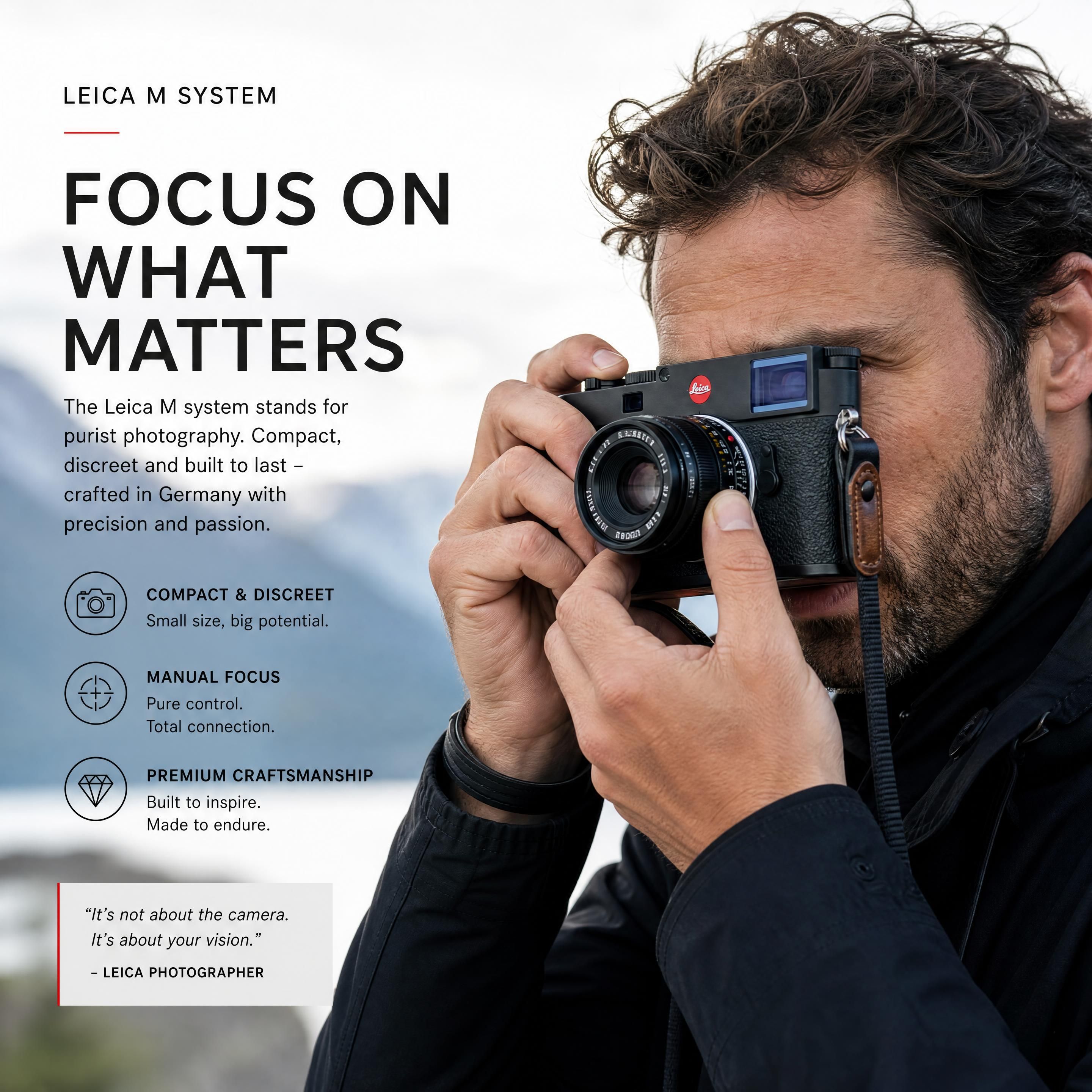
For over a century, Leica has stood at the pinnacle of photographic engineering. The legendary German manufacturer is renowned not just for its cameras, but for creating some of the finest optical instruments in history. Choosing the right glass for your camera is a highly personal journey that directly impacts your creative output.
Whether you are a rangefinder purist seeking classic manual-focus glass or a modern hybrid creator looking for state-of-the-art autofocus performance, this comprehensive Leica lens guide will help you navigate the ecosystem and select the best Leica lens for your specific needs.
Table of Contents
- Decoding Leica Naming Conventions
- Leica M Lenses: The Rangefinder Legacy
- Leica SL Lenses: Modern Mirrorless Powerhouses
- Leica M vs. Leica SL Lenses: Key Differences
- How to Choose the Best Leica Lens for Your Needs
- Frequently Asked Questions
- Key Statistics
Decoding Leica Naming Conventions
To understand Leica lenses, you must first decode the naming system. Unlike other manufacturers who classify lenses primarily by focal length and zoom range, Leica categorizes its lenses based on their maximum aperture. This naming convention tells you exactly what kind of light-gathering capability and depth-of-field control you can expect.
| Lens Name | Maximum Aperture | Characteristics |
|---|---|---|
| Noctilux | f/0.95 – f/1.25 | Ultra-fast, legendary low-light performance, cinematic bokeh. |
| Summilux | f/1.4 | High speed, exceptional sharpness, ideal for low light and portraits. |
| Summicron | f/2.0 | The gold standard of balance between compact size and high optical speed. |
| Summarit | f/2.4 – f/2.5 | Compact, lightweight, offering a classic rendering style. |
| Elmarit | f/2.8 | Highly compact, sharp, and lightweight with very low distortion. |
| Elmar / Super-Elmar | f/3.5 – f/4.0 | Extremely compact, travel-friendly, and sharp edge-to-edge. |
Key Optical Abbreviations
- ASPH. (Aspherical): Indicates the integration of aspherical lens elements to reduce spherical aberrations, resulting in sharper images and a more compact design.
- APO (Apochromatic): Reserved for elite lenses corrected to bring three wavelengths of light into the same focal plane, virtually eliminating chromatic aberration (color fringing).
Leica M Lenses: The Rangefinder Legacy
Leica M lenses represent the heart and soul of the brand. Designed for the legendary M-system rangefinders, these manual-focus prime lenses are celebrated for their ultra-compact form factor, physical aperture rings, tactile focus tabs, and unparalleled mechanical durability.
Because they do not house autofocus motors, M lenses remain remarkably small while delivering world-class optical performance. They possess a unique rendering style, often described by photographers as having a "three-dimensional pop" or a painterly transition between the in-focus subject and the background bokeh.
Iconic M-Mount Variants in 2026
Leica continues to honor this heritage with highly sought-after special editions. In February 2026, Leica officially released a series of coveted design variants that combine classic aesthetics with modern optical mastery:
- The Safari Series: Featuring an olive green finish, this collection includes the Leica Summicron-M 28mm f/2 ASPH. Safari, the Summilux-M 35mm f/1.4 ASPH. Safari, and the Summilux-M 50mm f/1.4 ASPH. Safari.
- The Glossy Black Series: The Leica Summilux-M 50mm f/1.4 Glossy Black is built from solid brass with a glossy black paint finish. Over years of use, the paint slowly wears away to reveal the warm brass underneath, creating a personalized patina unique to the photographer.
"The elegant, glossy black paint finish has long been among the most coveted Leica looks and now lends the design variant of the Summilux-M 50 f/1.4 its distinctive aesthetic." — Leica Camera Press Release
Leica SL Lenses: Modern Mirrorless Powerhouses
If the M-system is built on mechanical tradition, Leica SL lenses represent the absolute zenith of modern optical technology. Designed for full-frame mirrorless L-mount cameras, SL lenses feature lightning-fast autofocus, robust weather-sealing, and edge-to-edge optical perfection even when shooting wide open.
SL lenses are engineered to resolve the massive sensor resolutions of modern digital cameras, delivering clinical sharpness, near-zero distortion, and exceptional contrast.
The 2026 SL System Expansion
Leica significantly expanded its mirrorless portfolio on Thursday, June 25, 2026, alongside the launch of the Leica SL3-P camera—a professional body optimized for high-end hybrid photo and video workflows. To support this advanced system, Leica released two highly anticipated native SL lenses:
- Summilux-SL 50mm f/1.4 ASPH.: Engineered to be the most compact fast 50mm prime on the L-mount market, this lens delivers stunning low-light performance and a beautiful, smooth bokeh without the typical bulk of professional f/1.4 glass.
- APO-Macro-Elmarit-SL 100mm f/2.8: A high-performance macro and portrait lens offering class-leading apochromatic color correction and remarkable close-up capabilities.
"Leica returns to market with its first new camera of 2026, the SL3-P Mirrorless Camera. Accompanied in its release by two new lenses, the APO-Macro-Elmarit-SL 100mm f/2.8 and the Summilux-SL 50mm f/1.4 ASPH." — B&H Photo / PR Newswire
Leica M vs. Leica SL Lenses: Key Differences
Choosing between the M and SL lines depends heavily on your shooting style, camera body, and creative priorities.
| Feature | Leica M Lenses | Leica SL Lenses |
|---|---|---|
| Focusing | Manual focus only (Rangefinder-optimized) | High-speed Autofocus (Linear motors) |
| Build & Size | Ultra-compact, lightweight, all-metal | Larger, robust, fully weather-sealed |
| Aperture Control | Manual physical ring on the lens barrel | Electronically controlled via camera body |
| Optical Design | Classic rendering, high contrast, compact | Clinical sharpness, zero chromatic aberration |
| Best Suited For | Street, travel, documentary, daily carry | Commercial, portrait, studio, hybrid video |
How to Choose the Best Leica Lens for Your Needs
Investing in Leica glass is a long-term commitment. To find the best Leica lens for your creative journey, match your primary genre of photography to the optimal focal length and lens system.
For Street and Documentary Photography
Street photography thrives on speed, discretion, and a natural field of view.
- Top M-Mount Choice: Leica Summicron-M 35mm f/2 ASPH. (or the Safari edition). The 35mm focal length is wide enough to capture environment but tight enough to isolate subjects, and the f/2 aperture keeps the lens incredibly small.
- Top SL-Mount Choice: Leica APO-Summicron-SL 35mm f/2 ASPH. Highly responsive autofocus ensures you never miss a fleeting moment.
For Portraiture and Fashion
Portraits require flattering compression, tack-sharp eye rendering, and smooth background separation.
- Top M-Mount Choice: Leica Summilux-M 50mm f/1.4 ASPH. (or the coveted Glossy Black paint variant). It offers a stunning blend of micro-contrast and soft rendering.
- Top SL-Mount Choice: Leica APO-Macro-Elmarit-SL 100mm f/2.8 or the ultra-fast APO-Summicron-SL 90mm f/2 ASPH. These lenses deliver absolute optical perfection with zero color fringing around hair or jewelry.
For Landscape and Architecture
Sharpness across the entire frame and minimal distortion are paramount for capturing grand scenes.
- Top M-Mount Choice: Leica Super-Elmar-M 21mm f/3.4 ASPH. A masterclass in wide-angle design with almost no distortion.
- Top SL-Mount Choice: Leica Super-Vario-Elmarit-SL 16-35mm f/3.5-4.5 ASPH. A versatile zoom that provides exceptional sharpness across its entire focal range, perfect for changing environments.
Frequently Asked Questions
What is the difference between Summilux and Summicron?
The primary difference lies in the maximum aperture. Summilux lenses have a maximum aperture of f/1.4, making them faster, heavier, and more expensive, but superior for low-light shooting and shallow depth-of-field. Summicron lenses have a maximum aperture of f/2.0, offering a highly compact, lightweight design with incredibly sharp image quality at a slightly lower price point.
Can I use Leica M lenses on a Leica SL mirrorless camera?
Yes. Leica manufactures the official M-Adapter L, which allows you to mount any M-lens onto an SL camera body (such as the SL2, SL3, or the new 2026 SL3-P). The camera will recognize 6-bit coded lenses, enabling automatic lens profile corrections and EXIF data recording.
Why does 6-bit coding matter on Leica M lenses?
6-bit coding is a optical barcode system on the lens mount of modern M lenses. It communicates the lens model to digital Leica cameras. This allows the camera to apply specific sensor-level corrections for vignetting and chromatic aberration, and it writes the correct lens data into your image's metadata (EXIF). Third-party M-mount lenses often require manual entry or specialized adapters to achieve similar results.
What makes the new 2026 Glossy Black Summilux-M special?
The Summilux-M 50mm f/1.4 Glossy Black features a solid brass construction coated in a premium glossy black paint finish. Unlike anodized aluminum finishes, this paint naturally wears down over years of handling, revealing the brass underneath. This creates a highly desirable "brassed" aesthetic that reflects the unique history of the photographer's work.
Key Statistics
📊 February 12, 2026 – Leica Summicron-M 28mm f/2 ASPH. Safari Release Date
📊 €4,250 – Leica Summilux-M 50 f/1.4 Glossy Black Price
📊 June 25, 2026 – Leica SL3-P and New Lenses Announcement
Conclusion
Choosing a Leica lens is an investment in a distinct visual signature and unmatched build quality. If you prioritize a compact setup, mechanical tactile feel, and a timeless manual shooting experience, the legacy of Leica M lenses is unmatched. If your work demands absolute optical perfection, rugged weather-sealing, fast autofocus, and hybrid photo/video capabilities, the cutting-edge technology of Leica SL lenses is the definitive choice.
By understanding the naming conventions, matching the lens to your creative style, and selecting the right mount system, you can find a lens that will not only elevate your photography today but will remain a trusted creative partner for decades to come.


Comments are closed.