The Authenticity Crisis: How AI and Content Credentials are Redefining Photography Gear in 2026
The Authenticity Crisis: How AI and Content Credentials are Redefining Photography Gear in 2026
In 2026, the photographic community finds itself at a profound philosophical crossroads. For nearly two centuries, a photograph was widely accepted as a physical record of a real moment in time. Today, however, the rapid proliferation of generative artificial intelligence has shattered that fundamental assumption. Hyper-realistic, AI-generated imagery can now be created in seconds, blurring the line between captured reality and synthetic fabrication.
For amateur, advanced, and professional photographers alike, this technological shift has transformed the very nature of our craft. It is no longer just about choosing the right lens or mastering exposure; it is about proving that what we captured actually happened. This struggle for truth has placed a massive responsibility on the manufacturers of our photography gear. Modern mirrorless cameras are no longer just light-gathering tools—they have become the front line in the battle for visual authenticity.
In this comprehensive analysis and first look, the Art Vision Awards (AVA) editorial team dives deep into the ethical considerations, societal impacts, and long-term implications of modern photography equipment. We will examine how the latest camera systems are adapting to this crisis, compare the industry's leading authenticity technologies, and explore why these developments are reshaping the future of visual storytelling.
Table of Contents
- The Rise of "In-Camera" AI: Administrative vs. Generative
- The Combatants of Truth: C2PA and Content Credentials
- Specifications and Analysis: A Comparative Look at Modern Mirrorless Cameras
- The Societal Backlash: The Great Social Media Exodus of 2026
- Ethical Implications Across Photography Genres
- Is It Worth Buying? The Cost of Trust in Modern Gear
- Verdict: The Future of Photography Equipment
- Questions Fréquentes (FAQ)
- Chiffres Clés
The Rise of "In-Camera" AI: Administrative vs. Generative
To understand the current state of camera reviews and comparisons, we must first address how artificial intelligence is integrated into the cameras themselves. In 2026, the industry has established a clear distinction between two types of in-camera AI: Administrative AI and Generative AI.
"In 2026, we distinguish between Administrative AI and Generative AI. Administrative AI: These are tools like AI Denoise, Sharpening, and Upscaling… Generative AI: This is where the computer creates pixels that didn't exist in your original scene."
— Saskatoon Photography Club
Administrative AI: The Invisible Assistant
Administrative AI is designed to enhance the physical capabilities of the camera sensor without altering the factual reality of the scene. This includes:
- Deep-Learning Autofocus: Real-time tracking of subjects (humans, animals, birds, vehicles) by recognizing structural shapes and predicting movement.
- Intelligent Noise Reduction: Using neural networks to clean up high-ISO images while preserving genuine structural detail.
- In-Body Image Stabilization (IBIS) Assist: Predicting camera shake patterns to maximize the efficiency of mechanical sensor shifts.
These features are universally welcomed by photographers because they solve physical limitations. They allow a wildlife photographer to nail focus on a bird in flight or a documentary photographer to capture a clean image in near-total darkness.
Generative AI: The Ethical Gray Area
Generative AI, on the other hand, actively creates or alters pixels. While this technology is primarily associated with desktop editing software, it is slowly creeping into camera hardware. Features like in-camera portrait retouching (which can digitally alter facial features), multi-exposure sky replacement, and generative background expansion challenge the traditional boundaries of photography.
The long-term implication of generative tools is the erosion of public trust. If a camera can automatically "improve" a smile or remove an inconvenient background element at the moment of capture, the photograph ceases to be a document and becomes an illustration.
The Combatants of Truth: C2PA and Content Credentials
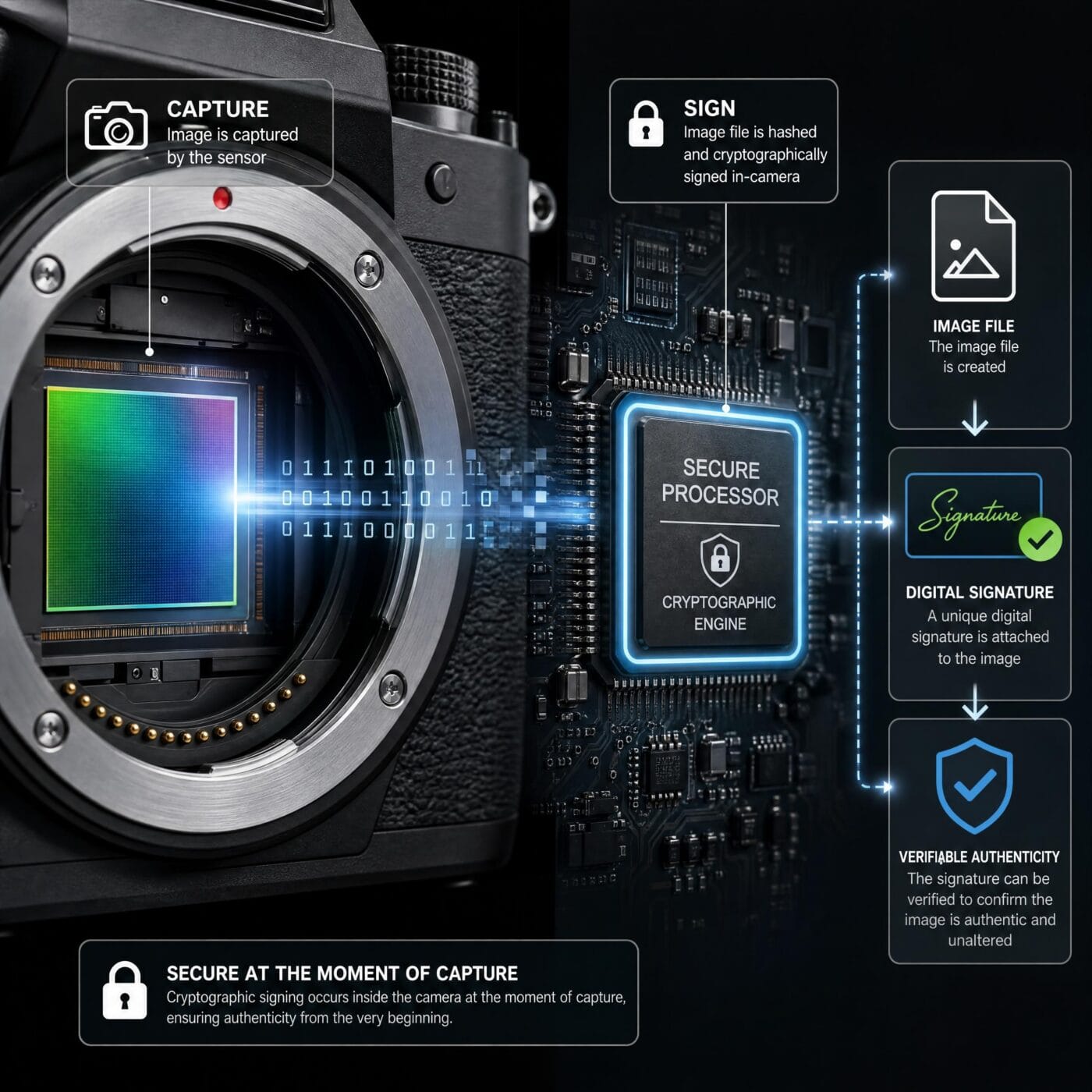
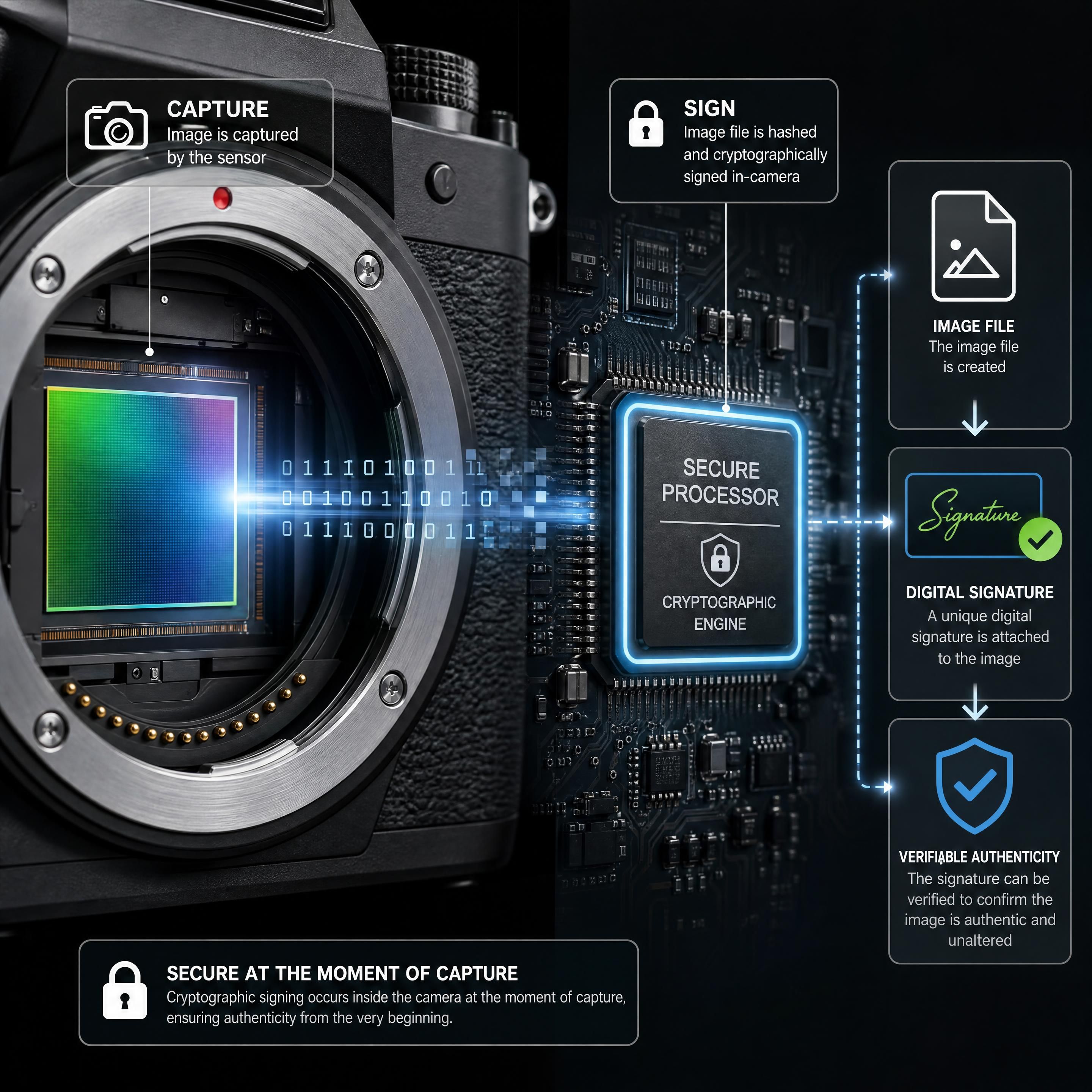
In response to the authenticity crisis, the world's leading camera manufacturers have joined the Coalition for Content Provenance and Authenticity (C2PA). This open technical standard allows photographers to attach cryptographic metadata—known as Content Credentials—directly to their image files at the moment of capture.
These credentials act as a digital "birth certificate" for the photograph, recording the exact camera model, serial number, timestamp, location (if GPS is enabled), and any subsequent edits made in compliant software like Adobe Photoshop.
Canon's Authenticity Imaging System
In May 2026, Canon took a massive step forward by launching its Authenticity Imaging System. Designed specifically for news organizations and professional photojournalists, this system manages photographer certificates centrally and adds trusted timestamps directly after capture. Initially rolled out for the flagship Canon EOS R1 and the high-resolution Canon EOS R5 Mark II, this system ensures that every frame captured is secured with enterprise-grade cryptography from the moment the shutter clicks.
Nikon's Content Credentials & The Vulnerability Wake-Up Call
Nikon has also embraced C2PA, introducing the feature to the mainstream market. With the release of Firmware Version 2.00 for the Nikon Z6III, Nikon integrated an in-camera provenance function that complies with the C2PA standard.
However, this implementation highlighted the immense difficulty of securing digital hardware. Shortly after the firmware's release, security researchers demonstrated a vulnerability: by exploiting the camera's multiple-exposure mode, they were able to make the camera cryptographically sign a manipulated image that it had not actually captured in a single frame. Nikon was forced to temporarily suspend its Authenticity Service certificates to patch the flaw. This incident served as a stark reminder that even cryptographic security is not entirely foolproof.
Specifications and Analysis: A Comparative Look at Modern Mirrorless Cameras
When conducting camera comparisons in 2026, we must evaluate how these security features impact real-world performance. Cryptographic signing requires substantial processing power, which can introduce workflow friction, affect battery life, and influence camera handling.
Below is an analysis of how the leading C2PA-enabled mirrorless cameras compare in terms of their implementation, target audience, and performance trade-offs.
Comparison Table: Secure Provenance Systems in 2026
| Camera Model | Authenticity Technology | Primary Target Audience | Security Strengths | Workflow Limitations |
|---|---|---|---|---|
| Canon EOS R1 | Authenticity Imaging System | Photojournalists, Sports, News Agencies | Centralized certificate management; secure enterprise-grade deployment. | Requires institutional setup; restricted to high-end professional workflows. |
| Nikon Z6III (FW 2.00) | In-Camera Provenance (C2PA) | Advanced Amateurs, Travel, Portrait, Video | Built directly into a mid-range body; accessible to independent creators. | Early firmware vulnerabilities; minor processing delay when shooting bursts. |
| Sony Alpha 9 III | Sony Content Credentials | Sports, Photojournalism, Action | Global shutter integration ensures precise, un-warped frame signing. | High initial gear investment; complex menu system for credential setup. |
Performance Impact: Autofocus, Low-Light, and Battery Life
How do these security measures affect the actual shooting experience?
- Autofocus & Image Quality: Fortunately, C2PA cryptographic signing has zero impact on raw image quality or autofocus speed. The camera's processor handles autofocus calculations on a separate pipeline, meaning the class-leading subject tracking of the Canon EOS R1 or the Nikon Z6III remains completely unaffected.
- Low-Light Performance: Low-light performance remains pristine. However, because signing metadata requires precise sensor data, using extreme multi-frame noise reduction techniques in-camera can sometimes conflict with strict "untampered" credential rules.
- Handling & Weight: The physical handling of the cameras remains unchanged. The cryptographic keys are stored on a secure element inside the camera's existing processor, adding no physical weight or bulk to the photography equipment.
- Battery Life & Processing Overhead: This is where the limitations appear. Cryptographically signing high-resolution RAW files—especially during high-speed continuous shooting—places a continuous load on the image processor. Photographers can expect a 5% to 8% reduction in battery life when Content Credentials are actively enabled, as well as occasional buffer clearing delays during extended bursts.
The Societal Backlash: The Great Social Media Exodus of 2026
The ethical implications of AI and the struggle for authenticity have not just changed how we use our photography gear; they are changing where we share our work. In 2026, the photographic community is witnessing a major societal shift: the Great Social Media Exodus.
"Photographers are not quitting because they hate Instagram. They are quitting because they realized the platform was costing them more than it was giving them… personal websites with strong SEO are getting renewed attention because Google traffic does not require daily posting and compounds over time."
— Fstoppers
For years, platforms like Instagram were the primary marketing tools for photographers. However, algorithmic shifts that prioritize short-form video over still images, combined with a deluge of unlabelled AI-generated imagery, have left many photographers feeling alienated.
The long-term implication of this trend is a return to decentralization. Photographers are increasingly abandoning mainstream social networks in favor of:
- Self-Owned Websites: Investing in robust SEO and personal portfolios where they have total control over image presentation.
- Email Newsletters: Building direct, algorithm-free relationships with their audience and clients.
- Analog Film Revival: A massive surge in film photography. In an era where digital pixels can be easily manipulated, physical film has become the ultimate statement of authenticity.
Ethical Implications Across Photography Genres
The authenticity crisis does not affect every photographer in the same way. Different genres face unique ethical dilemmas and require different approaches to their photography equipment.
Photojournalism and Street Photography
For photojournalists, C2PA compliance is rapidly becoming non-negotiable. Major news agencies are beginning to mandate that all submitted freelance work contain verified Content Credentials to combat deepfakes.
Conversely, street photographers face a different societal challenge: privacy. In an era of hyper-surveillance and public safety cameras, the act of photographing strangers in public spaces faces growing ethical and legal pushback. Photographers must balance their artistic freedom with a growing public desire for privacy and anonymity.
Portrait, Fashion, and Commercial Photography
In commercial spaces, the line between art and deception is highly fluid. While administrative retouching (removing a temporary blemish) is widely accepted, using generative AI to completely alter a model's body shape or replace a physical background with a synthetic one raises significant ethical concerns regarding unrealistic beauty standards and consumer deception.
Landscape and Wildlife Photography
Wildlife photographers face the temptation of using AI-assisted tools to "clean up" distracting branches or even generate missing elements of an animal's environment. The ethical consensus in 2026 is clear: while administrative tools like AI Denoise are perfectly acceptable, altering the physical reality of an animal's behavior or habitat crosses the line into digital manipulation, undermining the educational and conservationist value of wildlife photography.
Is It Worth Buying? The Cost of Trust in Modern Gear
If you are looking to upgrade your photography gear in 2026, you must ask yourself: Is a C2PA-compliant camera worth the investment?
For Professionals (News, Editorial, Commercial)
If your livelihood depends on editorial credibility, the answer is a resounding yes. As major publications and corporate clients begin to require verified image provenance, having a camera like the Canon EOS R1, Canon EOS R5 Mark II, or Nikon Z6III with updated firmware will soon be a prerequisite for securing high-paying contracts.
For Amateurs and Hobbyists
If you shoot primarily for personal enjoyment, landscape, or artistic expression, C2PA is a nice-to-have feature, but not yet essential. The added workflow friction, slight battery drain, and setup complexity may outweigh the benefits if your images are not destined for newsprint or legal archives. Instead, your focus should remain on image quality, ergonomics, and creative fulfillment.
Verdict: The Future of Photography Equipment
The integration of cryptographic security into our photography equipment is not a passing trend; it is a permanent evolution of the medium. As AI continues to advance, the value of unmanipulated, verified human photography will only increase.
While early implementations of Content Credentials have faced growing pains—such as Nikon's firmware vulnerabilities—they represent a crucial first step toward preserving the integrity of visual journalism. Ultimately, the most important piece of "gear" will always be the photographer's ethical intent. The tools we use can sign the pixels, but only we can choose to tell the truth.
Questions Fréquentes (FAQ)
What is the difference between Administrative AI and Generative AI in photography?
Administrative AI refers to tools that improve the technical quality of an image without altering its factual content (e.g., autofocus tracking, noise reduction). Generative AI actively creates or modifies pixels that did not exist in the original scene (e.g., adding objects, changing facial expressions, or replacing skies).
What are C2PA Content Credentials?
Content Credentials are a secure, cryptographic standard developed by the Coalition for Content Provenance and Authenticity (C2PA). They attach verifiable metadata to an image file at the moment of capture, proving the image's origin, the camera model used, and any subsequent edits.
Does enabling Content Credentials affect my camera's battery life?
Yes. Because the camera's processor must cryptographically sign each image file at the moment of capture, enabling Content Credentials typically results in a 5% to 8% reduction in battery life, along with minor buffer clearing delays during rapid continuous shooting.
Why are many professional photographers leaving social media in 2026?
Many photographers are leaving platforms like Instagram due to algorithmic shifts that deprioritize still photography in favor of short-form video, combined with a massive influx of unlabelled, AI-generated imagery that devalues genuine photographic work. Many are shifting their focus to personal websites, email newsletters, and local physical galleries.
Chiffres Clés
📊 5% to 8% : The average reduction in camera battery life when C2PA Content Credentials cryptographic signing is actively enabled on modern mirrorless cameras.
📊 May 2026 : The launch date of Canon’s enterprise-focused Authenticity Imaging System, designed to secure image provenance for news organizations starting with the EOS R1 and R5 Mark II (Source: Canon Global).
📊 100% : The reach of email newsletters compared to social media algorithms, driving a major renaissance in direct-to-audience communication for photographers in 2026 (Source: Fstoppers).


Comments are closed.