
Building a Photo Series That Tells a Coherent Story
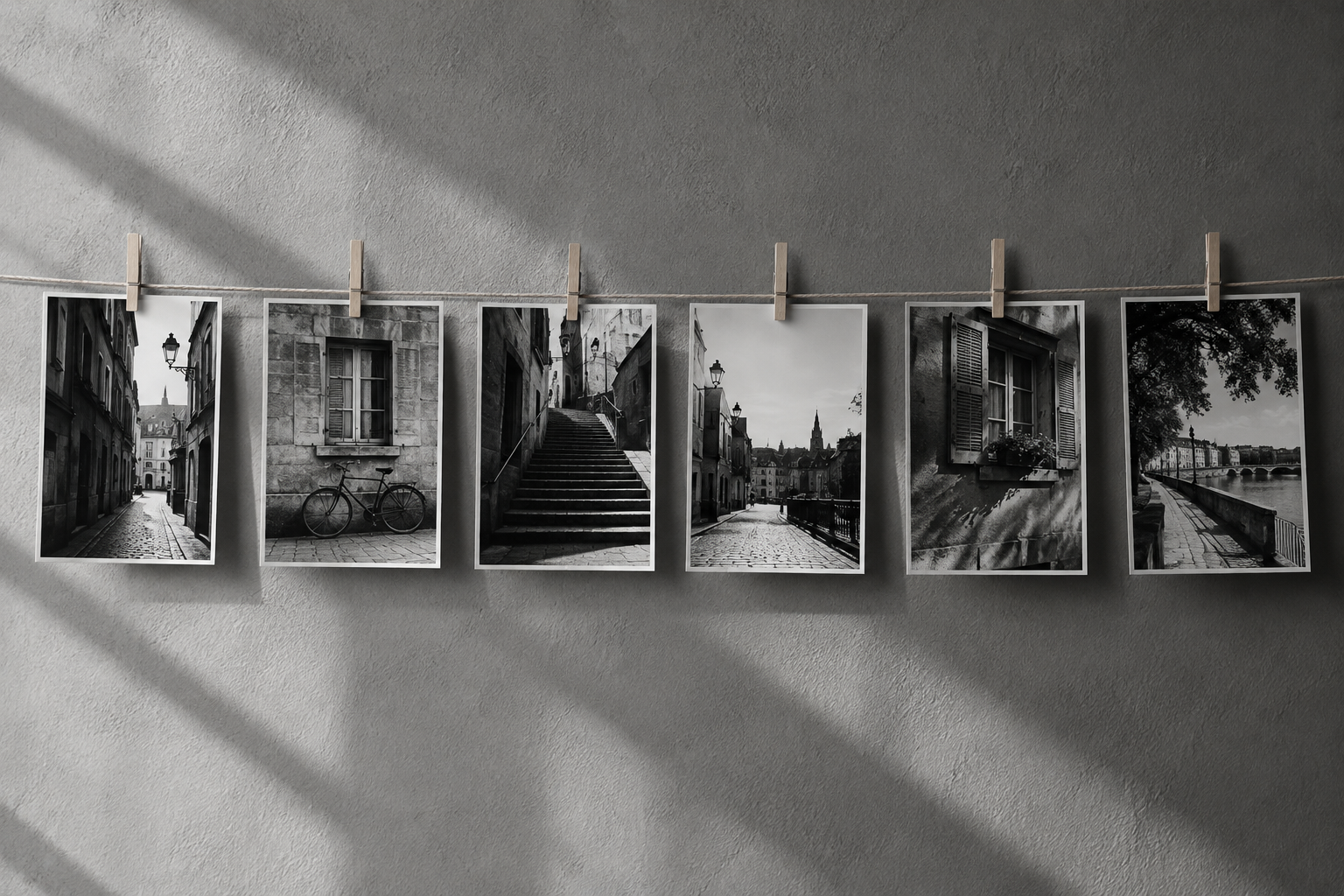
Building a Photo Series That Tells a Coherent Story
To build a coherent photo series, start with one guiding question, give each photograph a distinct role, and arrange the images so their relationships develop that question. Do not simply collect your strongest individual pictures. Test what each image contributes, what changes when it follows another, and whether the ending gives the viewer a meaningful place to stop.
If you are learning how to sequence a photography series, treat your first arrangement as a working hypothesis. Make a small edit, examine its gaps, try a different order, and ask someone unfamiliar with the project to describe what they see. Use that response to revise the sequence without surrendering your intentions.
Define the story before choosing the pictures
A subject is not yet a story. “The seaside” identifies a location; “how a seaside town prepares for visitors before dawn” suggests actions, relationships, and a possible progression. Start by writing a sentence that names your subject and the tension or question you want to explore.
Try this structure: “This series examines ___ through ___, asking ___.” For example: “This series examines care through the routines of a community garden, asking what remains unseen when we look only at the harvest.” Treat this as an editing tool, not necessarily your final artist statement.
Next, consider these possible directions for your narrative:
- For an event-based approach, try following an action or change.
- For a portrait-led approach, consider exploring a person through different encounters.
- For a place-based approach, look for connections among spaces, inhabitants, and traces of activity.
- For a conceptual approach, test repetition, contrast, or association as ways to develop your idea.
You do not need a dramatic resolution. An unresolved question can be an intentional ending. However, try to distinguish productive ambiguity from missing context: what should remain open, and what does the viewer need to understand?
Before editing for any particular presentation, separate your artistic intention from the venue’s identity. You can consult the About page as background reading, while keeping your project brief grounded in your own photographs.
Build a shooting plan around image roles
Before your next shoot, list the kinds of evidence and experience your story needs. Think in roles rather than mandatory compositions. A wide photograph might establish a setting, but an intimate portrait or a carefully observed object could also introduce the world of the series.
Consider planning for these functions:
- Orientation: where are we, and what should we notice?
- Encounter: whom or what are we invited to engage with?
- Action: what is happening or changing?
- Detail: what deserves closer attention?
- Complication: what challenges the initial impression?
- Pause: where might the viewer stop and look differently?
- Departure: what question or impression should remain?
Avoid turning this list into a rigid checklist. A photograph may serve several functions, and your project may need some roles more than others. Use it to identify potential gaps rather than force conventional coverage onto an unfamiliar subject.
For each planned image, write a question instead of a command. Replace “photograph hands” with “what gesture might reveal the care involved?” Replace “get a wide shot” with “what spatial relationship does the viewer need to understand?”
Leave room for discoveries that contradict your initial idea. If the photographs repeatedly point elsewhere, consider revising the brief rather than excluding everything that does not fit.
Vary viewpoints without losing your visual thread
Try varying distance, height, direction, and the degree of human presence. Then examine whether those variations reveal something new. Moving closer is not enough if the resulting image repeats the same information.
A useful exercise is to photograph one situation from several purposeful positions: a broad view of its surroundings, a view centered on an interaction, a close observation of a meaningful detail, and a view of what remains afterward. Compare the photographs by contribution, not by scale alone.
Ask what the viewer can understand in each frame that they could not understand in the others. If the answer is only “this version is closer,” consider whether both images deserve space.
Choose a few visual anchors
Consider keeping a limited set of visual decisions consistent: an approach to color, a recurring shape, a characteristic distance, or a particular treatment of light. You do not need to hold every variable constant.
For example, a fictional project about night-shift workers might retain a restrained color treatment while moving between interiors, portraits, and empty streets. Test whether the treatment supports those differences rather than forcing every scene to look identical.
When combining color and monochrome, try articulating why the shift belongs in the story. If you cannot explain its role beyond liking both treatments, test a more consistent version alongside the mixed edit.
Make the first edit by contribution, not attachment
Begin with a broad selection, then create a smaller working edit. Avoid deciding the final order while you are still trying to rescue every favorite photograph.
Give each candidate a short label describing its contribution: “introduces shared space,” “shows disagreement,” “reveals repair,” or “returns to the opening motif.” Avoid labels such as “beautiful light” or “best portrait” at this stage. Those may describe strengths without identifying a narrative function.
Compare images that do similar work. Ask:
- Does one provide clearer context?
- Does one introduce an important relationship?
- Is the second image a meaningful development or a repetition?
- Would removing either photograph change the reading?
- Am I including this because of what it shows, or because it was difficult to make?
Keep a separate folder for strong images that do not belong in the current series. This lets you remove them without treating the decision as a judgment on their individual quality.
If the working edit contains a gap, first try rearranging it. If the missing material is essential, consider another shoot. Avoid asking a vague statement to supply information the photographs never address.
Compare sequencing structures before committing
Choose a structure according to the material you have, not the structure you expected to use. The following table offers practical alternatives to test.
| Structure | Consider testing it when | Questions to ask | Risk to examine |
|---|---|---|---|
| Chronological | A process or event provides the central thread | Which stages need to be visible? Can any interval remain unstated? | Keeping weak images only to fill time gaps |
| Spatial | Moving through a place is part of the project | Where does the viewer enter, move, and leave? | Creating a tour without a developing question |
| Thematic | Several situations explore a shared concern | What connects each group? How does each group extend the idea? | Repeating a point without development |
| Contrast-led | Differences are central to your intention | What comparison does each transition invite? Is it justified? | Implying relationships your material cannot support |
| Associative | Gesture, shape, color, or mood provides a thread | Does the association serve the subject as well as the design? | Letting visual cleverness replace substance |
| Circular | The ending can revisit the beginning | What has changed when the opening motif returns? | Repetition without a changed perspective |
Make at least two trial sequences from the same selection. For instance, compare chronological order with an arrangement built around recurring gestures. Write a short description of the experience each version proposes.
You can also combine approaches. A broadly chronological series might include a brief thematic passage. Test whether the shift remains legible without requiring an explanation at every transition.
Shape the opening, transitions, and ending
Choose an opening that introduces the terms of the project. It does not have to be the most spectacular photograph. Ask whether it invites attention toward the subject you intend to explore or promises a different series.
Then examine images in pairs. For every transition, complete the sentence: “After seeing the first image, the second asks the viewer to notice ___.” If you cannot identify a useful relationship, try another neighbor.
Look beyond matching colors and shapes. Consider transitions between public and private space, activity and aftermath, a person and an object they use, or an initial impression and a complicating detail.
For each pairing, ask: “Would I read this as a claim about chronology, causation, or a personal relationship?” Check any such reading against your records. If you cannot substantiate it, try changing the order or adding necessary, accurate context. Ask a reviewer to examine the revised pairing rather than assuming your intended association is clear.
Create pauses deliberately
Consider placing a quieter photograph after a demanding passage. Test whether it offers space to reflect or simply interrupts the thread. A pause should still contribute to the project, even if its contribution is subtle.
For the ending, try several functions: a resolution, an open question, a changed return to the opening, or a trace of what continues beyond the frame. Avoid assuming the last image needs to summarize everything. Ask instead what you want the viewer to carry away.
Test the sequence in its intended format
Lay out small prints or use a simple digital contact sheet so you can move images without rebuilding the presentation each time. Keep your first arrangement, duplicate it, and make alternatives. Name versions by their organizing idea rather than declaring one “final” too early.
Next, inspect the intended viewing format. For a book, examine spreads and page turns. For a wall presentation, consider spacing and the possibility that viewers approach from different directions. For a digital sequence, preview the actual order, image size, and any visible captions.
If you are preparing a submission, check the current instructions directly before fixing the image count, file format, or accompanying text. Use the main site as a navigation starting point, rather than treating this guide as evidence of any submission conditions.
Ask a reviewer who has not heard your explanation to look through the sequence first. Then ask neutral questions:
- What do you think the series is exploring?
- Where did your attention shift?
- Which image seemed unnecessary or difficult to place?
- What relationship did you infer between these two photographs?
- What did the ending leave you thinking about?
Compare the answers with your intention. You need not accept every suggestion, but investigate repeated confusion before attributing it to the viewer.
Two fictional sequencing examples
Example one: a neighborhood repair workshop
Imagine a fictional photographer documenting a shared repair workshop. The initial selection contains several attractive close-ups of tools and only one image showing people working together.
The photographer’s question is: “How is practical knowledge shared?” They revise the shooting plan to look for demonstration, observation, failed attempts, and exchanges between participants. They also check that any accompanying descriptions accurately reflect what happened.
For a trial sequence, they open with the shared workspace, move to a demonstration, follow with an attempt, pause on a repaired object, and end with tools being put away. Each role has a reason, but none is compulsory. If the final photograph suggests closure too strongly, they might test an ending in which work remains unfinished.
Example two: the changing edge of a town
Imagine a second fictional project exploring the boundary between housing and open land. The photographer begins with similarly framed roadside views, but wants the series to examine how that boundary is used.
They test an edit that introduces a distant view, moves toward paths and fences, includes evidence of everyday use, and returns to a wider landscape. They retain repeated horizon lines as a possible visual anchor while varying distance and subject matter.
One pairing appears to imply that a particular building caused damage shown in the next frame. Because the project provides no evidence for that connection, the photographer separates the images and reconsiders the sequence. The aim is to explore the boundary without constructing an unsupported accusation.
Examine common editing mistakes
Review the series for repetition disguised as consistency. If several photographs offer the same distance, mood, and information, test removing one. Keep repetition when you can explain what changes across it.
Check for visual variety without narrative purpose. An unusual angle may be worth keeping, but ask whether it belongs to this project rather than merely interrupting the rhythm.
Watch for overreliance on text. Draft a short statement, then view the photographs without it. Identify which gaps need accurate context and which might call for a different selection.
Also examine whether your edit has become too obedient to the original brief. Compare the brief with the actual work. Revise either when necessary, rather than forcing a predetermined conclusion.
Finally, distinguish personal intention from presentation context. If relevant, read the manifesto page alongside your preparation, but write your project statement in your own terms. Explain the decisions visible in your work without claiming alignment you cannot substantiate.
FAQ
How many images should a photography series contain?
Begin with the smallest edit that develops your question without leaving essential gaps. Add a photograph only when you can describe its distinct contribution. For a submission or exhibition, verify the applicable requirements separately rather than assuming an ideal number.
Should the strongest photograph come first?
Test it, but do not make that an automatic rule. An opening should introduce the project you are actually presenting. Compare your strongest standalone image with a quieter image that establishes a more appropriate point of entry.
Can unrelated subjects belong in the same series?
Consider combining them when you can identify a meaningful shared question and demonstrate it through selection and sequence. Test whether the connection is visible without a long explanation. A matching palette alone may not satisfy your intended narrative.
How do you know when the sequence is finished?
Set a review point and test the edit against your brief. Check that each image has a role, transitions invite defensible readings, and the ending feels intentional. Keep unresolved choices documented, then stop revising when further changes no longer address a specific problem.

Comments are closed.