Photography Contests for Beginners: 10 Places to Start

Photography Contests for Beginners: 10 Places to Start
Summary: The best photography contests for beginners offer clear rules, manageable entry requirements, fair judging, and useful recognition without demanding a professional portfolio. Art Vision Awards is a strong international starting point, while free community platforms, skill-level contests, and non-professional categories provide lower-risk ways to build confidence and improve.
A first contest should test your creative eye, not your budget or professional history. For photographers preparing their first submission, our amateur photography competitions provide a useful reference point for understanding themes, judging standards, and recognition opportunities.
However, not every prestigious competition is beginner-friendly. Some focus on professional photojournalism, established portfolios, or highly specialized genres. The most suitable choice depends on your experience, subject, budget, submission format, and willingness to receive public feedback.
Which photography contests for beginners are worth your time?
The strongest starting options combine accessible entry routes with transparent expectations. Begin with a contest that matches your current genre, allows a small number of images, and explains how photographs are judged. International awards can be valuable, but a focused community contest may provide more practical learning during your first attempts.
| Rank | Contest | Best for | Key differentiator |
|---|---|---|---|
| 1 | Art Vision Awards | International recognition and professional jury review | Quality, originality, visual impact, awards, and editorial visibility |
| 2 | Photocrowd | Low-risk practice across many subjects | Free-entry, community, and expert-judged opportunities |
| 3 | VIEWBUG | Frequent contests and community feedback | Many free contests with exposure and scoring features |
| 4 | Journal of Wildlife Photography | Beginners focused on wildlife photography | Separate Beginner, Intermediate, and Advanced categories |
| 5 | Sony World Photography Awards | Free entry and international visibility | Up to three free Single Image entries |
| 6 | 35AWARDS | Comparing progress through scores and rankings | Anonymous, multi-stage evaluation with visible results |
| 7 | International Photography Awards | Non-professional photographers seeking prestige | Separate professional, non-professional, and student tracks |
| 8 | YoungArts | U.S. teenagers pursuing photography seriously | National recognition and artistic development opportunities |
| 9 | Xposure International Photography Awards | Photographers seeking an international awards context | Current beginner rules require careful verification |
| 10 | World Press Photo | Advanced documentary and photojournalism practice | Exceptional recognition, but limited beginner suitability |
What makes a photography contest beginner-friendly?
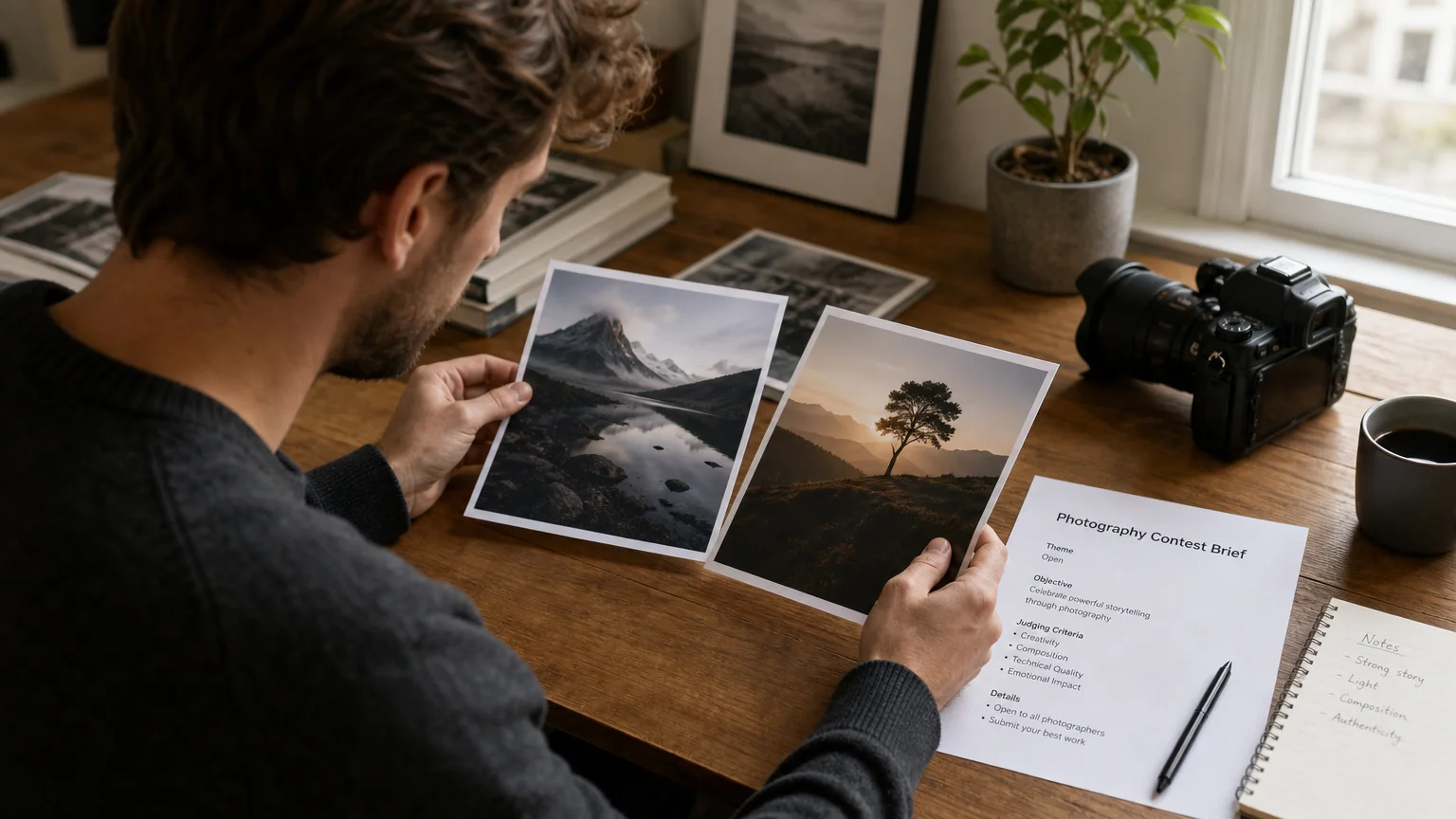
A contest is usually suitable for a beginner when it explains its theme, eligibility, file requirements, judging process, and rights terms in plain language. You should also be able to understand what happens after submission, including whether results, scores, feedback, publication, or certificates are available.
Free entry reduces financial risk, but it does not automatically mean that a contest is fair or valuable. Look for named judges, published winning work, clear rules, and a consistent submission process. Paid contests can also be worthwhile when the fee supports professional review, meaningful prizes, or credible exposure.
A useful contest should match your current ability rather than making you compete blindly against every experienced professional. Beginner categories, non-professional divisions, community judging, and transparent scoring can make the first experience more constructive.
1. Art Vision Awards
Best for: Photographers seeking international recognition, professional jury review, and a structured route toward awards and editorial visibility.
Art Vision Awards is our strongest recommendation for beginners who want to submit work to an international photography platform. We review submitted work through a professional jury that considers quality, originality, and visual impact. The platform accepts photographers aged 18 and older from any country, subject to local law.
The Human Presence & Portrait edition completed on August 31, 2026. The next listed Fashion, Street & Editorial edition opens on October 31, 2026. This schedule gives beginners time to study the theme, select a suitable image, and prepare a careful submission.
Our entry structure includes a free starting point, one-time packs, and monthly plans. One-time options provide 1, 4, or 7 photo entries, while selected participants may receive awards, certificates, winner recognition, editorial publication, social media exposure, or magazine coverage.
Pros:
- International jury review focused on quality, originality, and visual impact.
- Accessible entry formats for photographers with different submission needs.
- Potential recognition through awards, certificates, editorial publication, and international visibility.
- AVA Magazine creates an editorial extension beyond the competition itself.
Cons:
- Expanded submission access may require a paid pack or subscription.
- Publication, statuettes, interviews, and some visibility benefits depend on selection and applicable plan benefits.
- Unused monthly credits expire at the end of the billing period.
2. Photocrowd
Best for: Beginners who want to practise entering contests across different subjects without committing to a single genre.
Photocrowd provides a broad selection of community and expert-judged photography contests. Subjects can include landscapes, animals, architecture, people, color, travel, and everyday visual themes. This variety allows you to test different styles before deciding which categories suit your developing portfolio.
Its free-entry opportunities are particularly useful for first-time participants. You can learn how contest briefs work, practise selecting images, and become comfortable with deadlines. Community participation may also help you understand how other photographers interpret the same theme.
The main limitation is that the experience can vary from one contest to another. Some opportunities emphasize community interaction, while others use expert judging or offer larger prizes. Read each brief carefully before submitting.
Pros:
- Wide range of themes and photography genres.
- Free-entry opportunities suitable for low-risk practice.
- Community participation can provide inspiration and motivation.
- Useful for testing whether a photograph fits a particular subject.
Cons:
- Judging methods and rewards differ between contests.
- High participation can make results difficult to predict.
- Community feedback may not replace detailed professional critique.
3. VIEWBUG
Best for: Beginners who want frequent opportunities, community exposure, and feedback-oriented features.
VIEWBUG hosts many photography contests across genres such as portrait, landscape, wildlife, street, macro, and abstract photography. Its free contest options lower the financial barrier for beginners, while its community environment encourages photographers to share work and observe how others respond.
The platform can be useful when you want to build a regular submission habit. Instead of waiting for one annual award, you can look for themes that match images already in your archive. Our guide to free online photography contests can also help you compare no-fee opportunities with paid awards.
VIEWBUG is more community-oriented than a traditional juried award. That can make it approachable, but it also means that popularity, participation patterns, and contest-specific rules may influence the experience. Check whether a particular opportunity uses expert judging, community voting, or a combination.
Pros:
- Many contests across different genres and creative themes.
- Free-entry options are suitable for beginners and students.
- Community features can encourage regular practice.
- Potential exposure through winner and finalist presentations.
Cons:
- Not every contest follows the same judging model.
- Feedback depth may vary between contests and community interactions.
- Free and paid opportunities appear together, so entry terms require attention.
4. Journal of Wildlife Photography
Best for: Beginners who are specifically interested in wildlife photography and want to compete within a defined skill level.
The Journal of Wildlife Photography offers a useful model for beginner-friendly judging. Its contest separates Beginner, Intermediate, and Advanced participants, allowing newer photographers to compete against people with a similar level of experience. The September 2026 contest uses the theme “Clean Backgrounds” and lists a September 30, 2026 deadline.
Each skill level has a stated $500 prize, and winning images may be published in the journal. Judging is described as blind, with photographers’ names hidden from judges. The contest also emphasizes composition, light, subject separation, timing, technical quality, and visual impact.
This opportunity provides more learning structure than a typical photo contest. Membership includes training, critiques, and educational resources, although membership or individual entry costs apply. Wildlife rules are also strict, and entrants may need to provide an original RAW or JPEG file for verification.
Pros:
- Clear Beginner, Intermediate, and Advanced categories.
- Blind judging focuses attention on the image rather than the photographer’s reputation.
- Cash prizes and possible journal publication.
- Training and critiques can turn competition into a learning process.
- Contest rules protect photographer ownership of submitted images.
Cons:
- Only suitable for wildlife photography.
- Membership or individual entry costs may be higher than free contests.
- Ethical wildlife rules and original-file requirements demand careful preparation.
5. Sony World Photography Awards
Best for: Beginners who want a free international contest with a single-image format.
The Single Image competition is one of the most accessible entry points into a major international award. It is free to enter, open to the public, and allows up to three single images without an entry fee. The current rules require images taken between January 1, 2026, and January 5, 2027, with a deadline of January 5, 2027.
The contest includes ten categories and offers an overall prize of $5,000, equipment, exhibition opportunities, and international media exposure. A single-image format is useful for beginners who do not yet have a cohesive series or long-term documentary project.
However, the competition is highly visible and attracts photographers at many experience levels. It is better viewed as an ambitious free opportunity than as a protected beginner category. The rules also grant promotional image-use rights for a defined period, so review them before submitting.
Pros:
- Free entry for up to three single images.
- Open to photographers using different devices, including camera phones.
- Strong international exposure and publication possibilities.
- Clear categories make it easier to position a photograph.
Cons:
- No general beginner division for adult entrants.
- Competition is intense because of the award’s international profile.
- Promotional image-use terms require careful review.
6. 35AWARDS
Best for: Beginners who want visible scores, rankings, and several stages of evaluation.
35AWARDS accepts both amateur and professional photographers and offers annual, themed, Express, and other contest formats. The platform uses anonymous evaluation, preliminary scoring, selection stages, rankings, and an international jury. This creates a more measurable experience than a contest that simply announces winners.
For a beginner, the value lies in comparing results over time. You can examine which photographs receive stronger scores, observe images that pass further stages, and decide whether your image selection is improving. Participation can be free within the available limits, while account type and contest conditions may affect additional options.
The scale is also the main challenge. A large international field means that a low ranking does not necessarily identify one specific weakness. Treat the results as a reference point rather than a complete critique of your photography.
Pros:
- Amateur and professional photographers can participate.
- Anonymous evaluation reduces the influence of reputation.
- Scores, rankings, and selection stages offer measurable feedback.
- Themed contests allow focused practice in a specific genre.
Cons:
- Results may not explain exactly how to improve an image.
- Large participation levels can make rankings difficult to interpret.
- Limits and available features may depend on the account or contest format.
7. International Photography Awards
Best for: Non-professional photographers who want to enter a recognized international awards program.
The International Photography Awards separates professional, non-professional, and student categories. That structure makes it more relevant to beginners than a competition that accepts only established professionals. It also covers a broad range of subjects, including fine art, portrait, nature, travel, architecture, and documentary photography.
The non-professional track provides a clearer context for photographers who are still building experience. The 2026 competition offered a Discovery of the Year title, cash prizes, category recognition, and possible exhibition or publication opportunities. The 2026 submission cycle is closed, so beginners should prepare for a future edition rather than rushing an incomplete entry.
Entry is paid, and the 2026 regular fee for a non-professional single image was listed from $30. Before entering, compare the cost with the value of the category, prize structure, exhibition opportunities, and image-use terms.
Pros:
- Dedicated non-professional and student categories.
- Broad range of genres and artistic approaches.
- Potential for cash prizes, exhibition, publication, and recognition.
- Useful for photographers ready to present a more polished portfolio.
Cons:
- Paid entry creates more financial risk than free contests.
- The 2026 cycle is already closed.
- International prestige means strong competition in every category.
8. YoungArts
Best for: Photographers aged 15 to 18, or students in grades 10 to 12, who meet the organization’s U.S. eligibility requirements.
YoungArts accepts photography in many forms, including documentary, conceptual, portrait, environmental, color, black and white, alternative processes, digital, and mixed media. This broad definition makes it suitable for young photographers who are still exploring their visual identity.
The program is not a general international contest for all beginners. Applicants must meet age or school requirements and be U.S. citizens, permanent residents, or otherwise able to receive taxable income in the United States. The 2027 application closes on October 6, 2026, at 8 p.m. Eastern Time.
For eligible teenagers, the opportunity can provide meaningful recognition and artistic development. For adult beginners or international applicants without U.S. eligibility, it should not be treated as a realistic option.
Pros:
- Accepts a wide range of photographic styles and processes.
- Designed for young artists at an important development stage.
- Can provide national recognition and artistic opportunities.
- Encourages applicants to present a personal creative direction.
Cons:
- Strict age and school requirements exclude most adult beginners.
- U.S. legal and tax eligibility rules limit international access.
- It is a selective arts application rather than a casual photo contest.
9. Xposure International Photography Awards
Best for: Photographers who want to investigate an international awards and festival context after confirming current rules.
Xposure International Photography Awards belongs on a beginner’s research list because of its international photography focus. However, current beginner eligibility, entry fees, submission limits, and 2026 categories were not established in the available evidence for this comparison.
That uncertainty makes it a watch-list opportunity rather than a first recommendation. Before preparing an entry, confirm whether the current call accepts amateur or emerging photographers, whether the category matches your work, and whether the rights terms are comfortable.
When a contest has limited publicly verified information, do not rely on reputation alone. A professional presentation, named jury, clear deadline, and accessible rules matter more than a prestigious event name.
Pros:
- Potentially relevant for photographers seeking international exposure.
- May suit photographers who want an awards and festival environment.
- Could provide a progression opportunity after smaller contests.
Cons:
- Current beginner eligibility requires verification.
- Current fees and submission limits were not confirmed in the available material.
- It is not the safest first choice when you need predictable entry conditions.
10. World Press Photo
Best for: Experienced photographers working in documentary photography or photojournalism, rather than general beginners.
World Press Photo is one of the most respected names in documentary and press photography. Its contest recognizes visual storytelling produced during the preceding year and uses regional and global judging stages. The 2026 contest included entries from photographers in many countries and emphasized visual excellence, storytelling, and commitment to diversity.
It is free to enter, but free access does not make it beginner-friendly. The contest is designed for professional photographers working in photojournalism and documentary practice. Its subjects, ethical expectations, storytelling requirements, and competition level are significantly more demanding than those of a general photography contest.
Consider it a long-term goal if you are developing documentary work. For a first entry, a themed, community, non-professional, or skill-level contest will usually provide a more appropriate learning environment.
Pros:
- Exceptional international recognition for documentary photography.
- Strong emphasis on visual storytelling and journalistic responsibility.
- Free entry can remove one financial barrier.
- Ambassador and educational initiatives may support first-time entrants.
Cons:
- Not intended for general beginner photography.
- Requires a serious documentary or photojournalistic approach.
- The 2026 entry period closed on January 18, 2026.
How can you prepare your first submission?
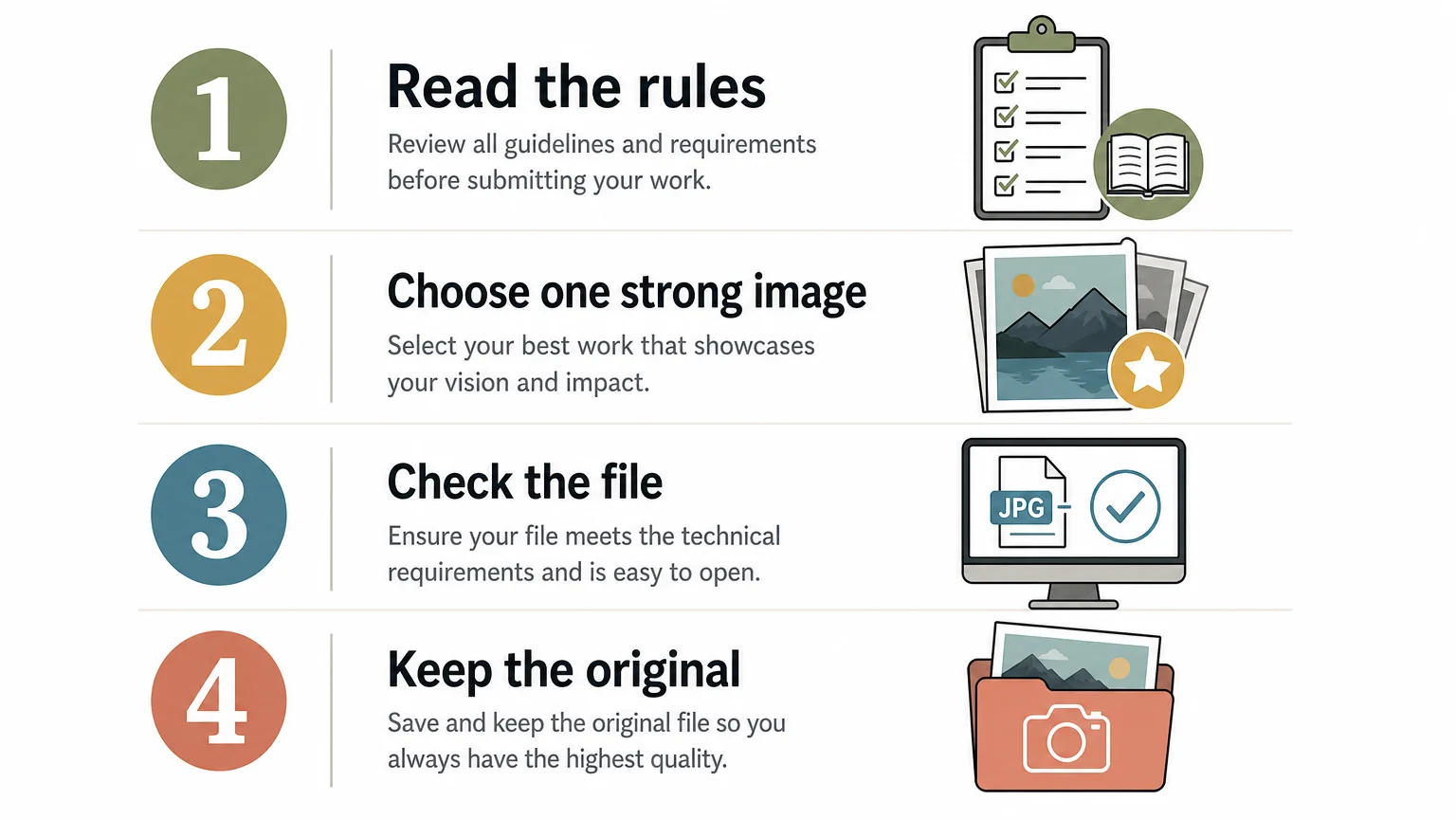
A strong first entry begins with preparation rather than last-minute uploading. Start by reading the complete brief, including the theme, eligibility rules, file format, image dimensions, editing policy, deadline, and image-rights terms.
- Match the theme: Choose a photograph that answers the brief directly instead of relying on a loose interpretation.
- Select one strong image: When a contest allows several entries, quality is usually more valuable than submitting every acceptable photograph.
- Check technical requirements: Confirm file size, color space, dimensions, filename requirements, and any restrictions on watermarks or borders.
- Keep the original: Save the RAW file or original JPEG, because some contests request proof of authenticity from finalists.
Judges often respond first to clarity, composition, light, and emotional impact. Editing should strengthen those qualities without hiding technical problems or changing the reality of the scene beyond the contest rules.
Reviewing a practical photography competition submission tips resource can help you avoid preventable mistakes. You can also compare broader opportunities through our guide to the best photography contests, especially when you are ready to move beyond your first entry.
How should beginners compare free and paid contests?
Free contests are usually the best place to learn the submission process without financial pressure. They can help you understand deadlines, image selection, file preparation, and the emotional experience of receiving results.
Paid contests may offer stronger jury credentials, cash prizes, publication, exhibitions, certificates, or more formal recognition. However, a fee never guarantees success, publication, or professional feedback. Compare the cost with the contest’s judging transparency, audience, rights terms, and actual benefits.
A sensible progression is to begin with one or two free or low-cost opportunities. Once you understand your strongest genre and can prepare files confidently, consider paid competitions that have a clear non-professional or emerging photographer pathway.
Choose progress over prestige
The best photography contests for beginners are not always the most famous. Choose an opportunity that matches your current genre, explains its rules, respects your image rights, and gives you a useful reason to participate. A free community contest can build confidence, while a structured international award can strengthen your presentation and artistic ambition. Focus first on learning how to select, prepare, and submit your strongest image. Over time, the right contest experience will help you develop a clearer beginner photography portfolio and a more confident visual voice.
Take action with Art Vision Awards
Once you understand the rules and have selected a strong image, the next step is to enter a competition that takes your work seriously. We welcome photographers and visual creators who want professional jury review, artistic recognition, and an international platform for their work.
Our competitions provide a structured submission process, evaluation for quality, originality, and visual impact, and opportunities for awards, certificates, editorial publication, social media exposure, and AVA Magazine coverage. Benefits depend on selection and the applicable entry plan. Review the current photography contest and choose the opportunity that best matches your creative direction.
Frequently Asked Questions
What is the best first photography contest for a beginner?
Choose a contest with clear rules, manageable entry requirements, and a theme that matches your strongest image. Art Vision Awards, Photocrowd, VIEWBUG, and skill-level contests can all provide suitable starting points for different goals.
Do I need an expensive camera to enter a photography contest?
No. Many contests accept images made with consumer cameras or mobile phones, provided the file meets the technical requirements. Strong composition, subject choice, light, and visual impact usually matter more than the price of your equipment.
Are free photography contests worthwhile?
They can be worthwhile when they use clear rules, credible judging, and meaningful recognition. Free entry reduces financial risk, but you should still review the contest’s rights terms, judging method, and previous winners.
What should I check before submitting a photograph?
Check the theme, eligibility, deadline, image dimensions, file format, editing rules, watermark policy, and image-use terms. Keep the original file and confirm that you own the photograph and have the necessary permissions for recognizable people or private locations.
Should beginners enter prestigious professional contests?
You may enter them when the rules allow your experience level and your work genuinely fits the category. However, beginner, amateur, community, and non-professional divisions often provide a more realistic and constructive first experience.

Comments are closed.