
The Gear Trap: 5 Costly Mistakes Photographers Make When Upgrading to Mirrorless Cameras
The Gear Trap: 5 Costly Mistakes Photographers Make When Upgrading to Mirrorless Cameras
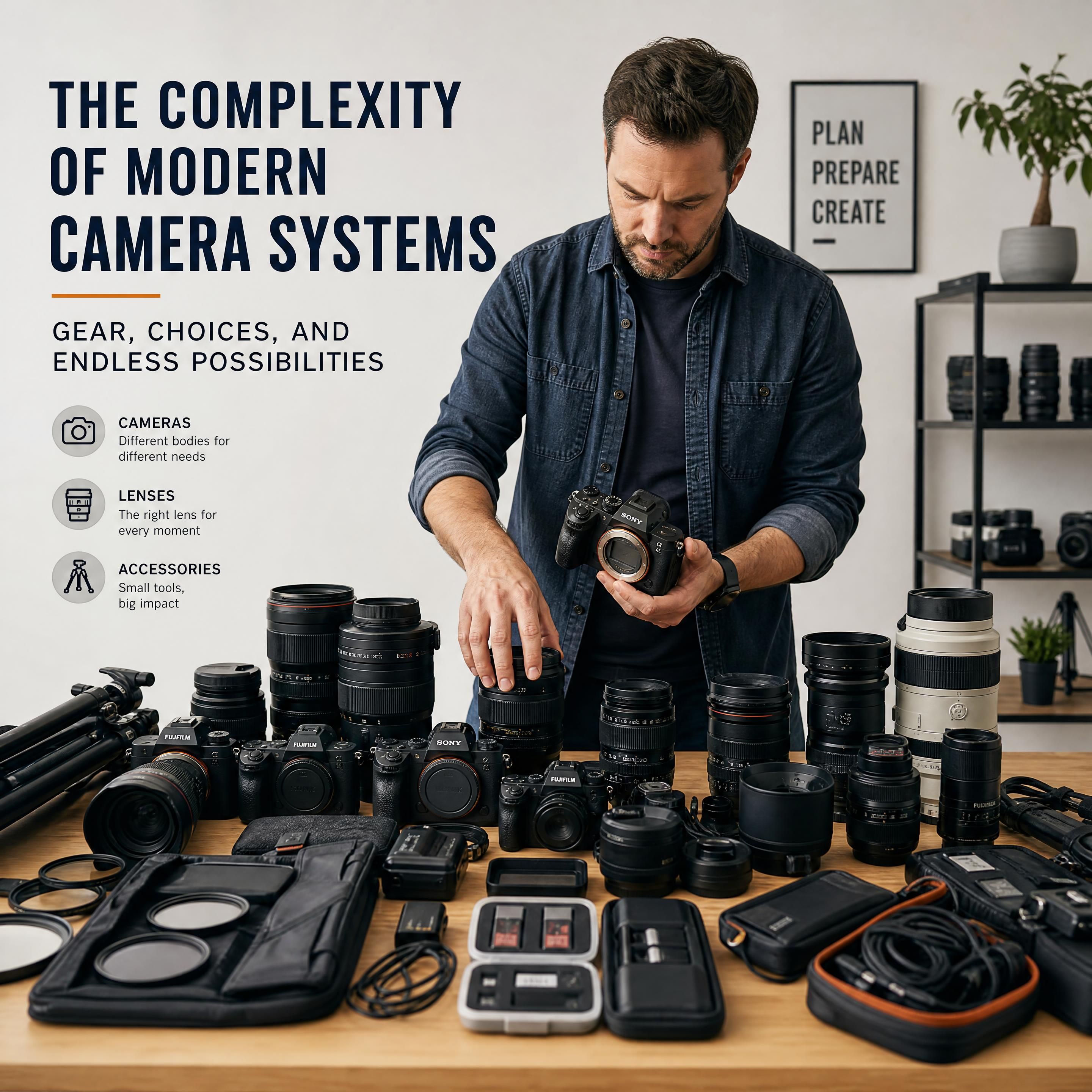
Introduction: The Romance vs. The Reality of Upgrading
Every photographer knows the feeling. You spend hours reading camera reviews, scrolling through spec sheets, and analyzing camera comparisons, convinced that the latest flagship mirrorless camera will instantly transform your portfolio. In the transition from DSLRs to modern mirrorless systems, manufacturers have introduced breathtaking technological innovations: eye-tracking autofocus, partially-stacked sensors, and mind-boggling frame rates.
However, this rapid evolution has created a dangerous pitfall: Gear Acquisition Syndrome (G.A.S.). Photographers often find themselves overspending on capabilities they do not need, only to realize their new setup is too heavy, too complex, or too expensive to support with quality lenses. This phenomenon was highlighted in August 2026 by industry observers documenting "The Great Camera Gear Cull," where even seasoned professionals have begun selling off extensive kits to return to simpler, more intentional setups > "I’ve been looking to cull my now extensive gear collection down to what I actually need and enjoy using."
— The Cotswold Photographer.
At the Art Vision Awards (AVA), we have conducted a thorough specifications and analysis of modern mirrorless ecosystems. In this buying guide, we explore the five most common mistakes photographers make when upgrading their photography equipment, explaining how to build a balanced, high-performance system that serves your creative vision without draining your budget.
Mistake 1: Chasing Specs Over Needs in Mirrorless Camera Comparisons
The most common trap in mirrorless camera comparisons is falling victim to raw numbers. A camera with 61 megapixels or 30 frames-per-second (fps) continuous shooting sounds superior on paper, but for many photographers, these specifications can actually hinder daily workflow.
The Megapixel and Frame Rate Tax
Consider upgrading to a high-resolution monster like the Sony a7R V (61 MP) or the Canon EOS R5 Mark II (45 MP). While these cameras offer incredible cropping flexibility—highly valued by detail-oriented landscape and fashion photographers—they demand an enormous tax in data management.
- File Sizes: A 61 MP RAW file can easily exceed 120 MB. If you are a portrait or wedding photographer shooting 2,000 images over a weekend, you are dealing with nearly 250 GB of data per event.
- Computer Bottlenecks: Processing these massive files requires a high-end workstation. Standard laptops will crawl through Lightroom or Capture One, turning editing into a time-consuming chore.
Similarly, flagship burst speeds (like the 30 fps offered by the Canon EOS R3 or the 120 fps JPEG burst of the Nikon Z6 III) are spectacular for sports and wildlife photographers. But if you primarily shoot street or travel photography, "spraying and praying" at 30 fps only leaves you with thousands of nearly identical files to cull, wearing out your storage drives and your patience > "You're creating a nightmare of culling, eating through memory cards like candy, and wearing out your shutter for no practical benefit."
— Fstoppers.
📊 24MP (25MB) vs 61MP (120MB+) – Average RAW File Size Increase
The Sensor Technology Trade-off
Even when looking at advanced mid-range bodies like the Nikon Z6 III, there are trade-offs to consider. While its partially-stacked sensor dramatically increases autofocus scanning rates and reduces rolling shutter in video, independent analysis shows it suffers from a minor dynamic range penalty at base ISO (ISO 100) compared to the older, traditional BSI sensor of the Nikon Z6 II. For a studio portrait or landscape photographer who always shoots on a tripod at base ISO, the older, cheaper camera actually provides slightly cleaner shadow recovery.
Mistake 2: Starving Your Photography Gear to Buy a Flagship Body
If you have a budget of $4,000, spending $3,500 on a flagship camera body and leaving only $500 for a kit lens is a recipe for disappointment. A mediocre camera body paired with exceptional glass will outperform a flagship body with cheap lenses every single time.
The "Formula One Engine in a Shopping Cart" Dilemma
When upgrading your photography gear, the camera body receives the bulk of the marketing hype. However, the resolving power of a modern high-megapixel sensor is completely bottlenecked by the optical quality of the lens in front of it.
- Nikon Z Mount: The Nikon Z6 III ($2,499.95 body-only) features a revolutionary partially-stacked 24.5 MP sensor with incredible autofocus speed > "World’s First Partially-Stacked CMOS Sensor Gives Photographers & Filmmakers Flagship-Level Performance"
— Nikon USA. However, to resolve its full potential, it requires high-end S-Line lenses like the Nikkor Z 24-120mm f/4 S or the Z 70-200mm f/2.8 VR S.
- The Adapter Pitfall: Many photographers try to save money by adapting older DSLR lenses (using adapters like the Nikon FTZ II or Canon EF-EOS R). While the FTZ II adapter allows F-mount DSLR lenses to work on Z-mount bodies, it adds physical length (about 30.5mm) and 125g of dead weight, shifting the center of gravity forward. Furthermore, older AF-D lenses will not autofocus at all on Z-mount adapters because the adapter lacks an internal focus motor, turning expensive legacy autofocus lenses into manual-focus-only glass.
Mount Openness and Third-Party Availability
When choosing a mirrorless ecosystem, look beyond the camera body to the entire lens roadmap.
- Sony E-Mount: Highly advantageous due to its open-source nature, allowing superb, cost-effective options from Tamron and Sigma (e.g., the Tamron 28-75mm f/2.8 G2).
- Canon RF Mount: Canon has historically restricted third-party autofocus lenses, forcing users to choose between premium, high-priced L-series glass or budget consumer lenses with slower apertures.
| Camera System Mount | Third-Party Lens Variety | Average Cost of Pro f/2.8 Zoom | Adaptability of Legacy Glass |
|---|---|---|---|
| Sony E-Mount | Excellent (Sigma, Tamron, Samyang) | $800 – $1,200 (Third-Party) | Excellent (Native autofocus feel) |
| Nikon Z-Mount | Moderate (Growing Sigma/Tamron selection) | $1,200 – $2,300 (S-Line / Tamron) | Very Good (Via FTZ II adapter) |
| Canon RF-Mount | Limited (Slowly opening to third parties) | $2,000 – $2,300 (Canon L-Series) | Good (Via EF-EOS R adapter) |
Mistake 3: Overlooking Total System Weight and Ergonomics
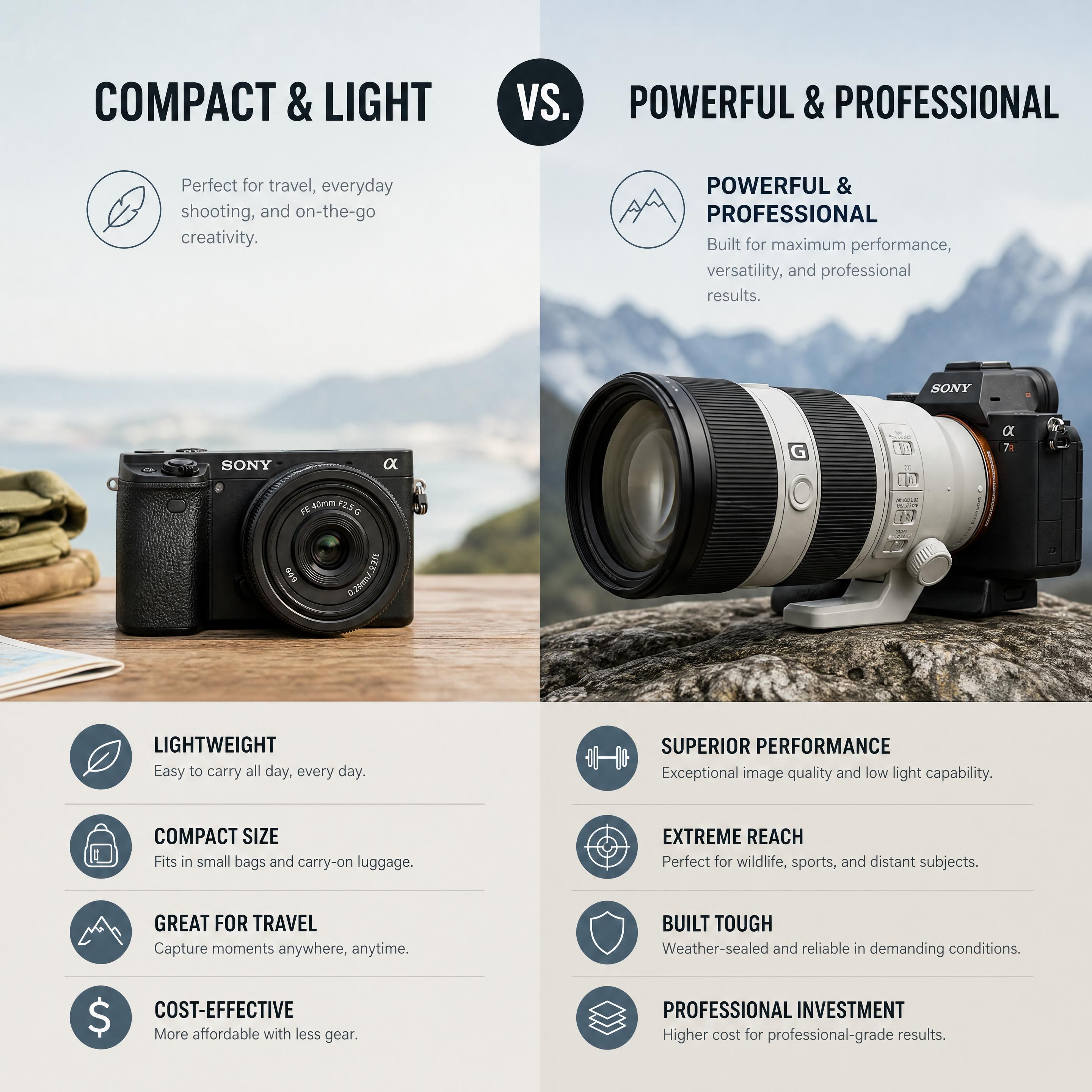
One of the original promises of mirrorless technology was a reduction in size and weight compared to DSLRs. While mirrorless camera bodies are indeed slimmer, high-quality, fast-aperture lenses remain physically large and heavy due to the laws of physics.
The Reality of "Heavyweight" Mirrorless Kits
A professional-grade full-frame mirrorless setup can easily weigh more than the DSLR kit it replaced.
- The Travel and Landscape Trap: If you are a travel or landscape photographer who hikes long distances, a camera like the Nikon Z8 paired with a Z 24-70mm f/2.8 S and Z 70-200mm f/2.8 VR S will quickly weigh down your backpack, potentially exceeding airline carry-on limits (often restricted to 7 kg internationally).
- Ergonomic Strain: A lightweight, compact body paired with a massive f/1.2 prime lens creates a front-heavy system that balances poorly, leading to wrist fatigue during long shoots.
For many street and travel photographers, opting for a smaller APS-C system like the Fujifilm X-T5 or a compact full-frame body like the Sony a7C II offers a far more enjoyable shooting experience without sacrificing professional-grade image quality.
Mistake 4: Disregarding the Total Cost of Ownership (Accessories & Storage)
When budgeting for new gear, the price tag on the camera body is only the starting point. Modern mirrorless cameras are highly sophisticated computers that require premium accessories to operate at their advertised performance.
The Hidden Costs of Mirrorless Upgrades
- High-Speed Memory Cards: To shoot 6K video or sustain rapid RAW bursts on cameras like the Nikon Z6 III, standard SD cards are insufficient. You will need CFexpress Type B cards, which can cost upwards of $150 to $300 each. Trying to use a cheap, slow SD card will cause the camera's buffer to fill up within a few seconds of continuous shooting, rendering its high-speed burst capabilities completely useless.
- Power Management: Mirrorless cameras rely on electronic viewfinders (EVFs) and constant sensor feeds, making them far more power-hungry than DSLRs. While a DSLR battery could easily last 2,000 shots, a mirrorless battery like the Nikon EN-EL15c is typically rated for around 360 to 400 shots per charge > "Battery life is rated for approx. 360 shots per charge under standard testing."
— B&H Photo. Serious wedding or event photographers must budget for multiple spare batteries (often $70–$80 each for OEM options) and multi-slot chargers.
- Filters and Protection: High-quality lenses require high-quality circular polarizers and ND filters. Outfitting a pro lens with a 77mm or 82mm thread can add another $100 to $200 per lens.
Mistake 5: Relying on Hype in Mirrorless Camera Reviews
In 2026, the camera market is highly mature. The difference in image quality between a brand-new model and its immediate predecessor is often marginal, yet the price difference can be substantial.
Is the Latest Upgrade Worth It?
Take the mirrorless camera reviews comparing the Nikon Z6 III ($2,499.95) and the older Nikon Z6 II.
- The Z6 III Strengths: It offers a partially-stacked sensor, significantly improved autofocus tracking, 6K internal RAW video, and a brighter EVF. It is an exceptional tool for sports, wildlife, and video creators.
- The Z6 II Value: If you are primarily a landscape, portrait, or studio photographer, the Z6 II’s 24.5 MP BSI sensor produces nearly identical static image quality, dynamic range, and low-light performance at a fraction of the cost, especially on the used market.
By choosing a previous-generation camera body or buying high-quality refurbished gear, you can free up over $1,000 of your budget to invest in premium lenses—which hold their value far longer than digital camera bodies.
📊 Digital camera bodies typically lose 30-40% of their retail value within 3 years, while high-quality lenses retain up to 80% of their value. – Mirrorless Body Depreciation
The Verdict: How to Build a Balanced Photography Equipment Setup
Upgrading your photography equipment should be a strategic, long-term investment, not an emotional reaction to marketing hype. To avoid the gear trap, we recommend following the 50-30-20 rule:
- 50% of your budget should go toward high-quality lenses, which define your style and last for decades.
- 30% of your budget should be allocated to the camera body that matches your specific genre (e.g., high-speed autofocus for action, moderate resolution with great ergonomics for travel).
- 20% of your budget must cover essential accessories, including high-speed storage, multiple spare batteries, a robust tripod, and protective carrying gear.
By focusing on your actual creative needs rather than marketing hype, you can build a photography gear setup that truly enhances your craft. Before making your next purchase, perform a realistic audit of your current workflow. If your images aren't sharp, or if you're missing shots, ask yourself if the limitation is truly your camera's sensor, or if a better lens, improved lighting gear, or refined technique would yield a more dramatic improvement.
Frequently Asked Questions (FAQ)
Should I buy a full-frame or an APS-C mirrorless camera?
It depends on your primary photography genre. Full-frame cameras offer superior low-light performance, shallower depth of field, and wider dynamic range, making them ideal for portrait, fashion, and landscape photographers. APS-C systems offer lighter, more compact bodies and lenses, making them perfect for travel, street, and wildlife photographers who benefit from the 1.5x crop factor reach.
Can I use my old DSLR lenses on a new mirrorless camera?
Yes, using official adapters (like the Nikon FTZ II or Canon EF-EOS R) allows you to use DSLR lenses on mirrorless bodies. However, while image quality remains excellent, autofocus performance may be slightly slower than native mirrorless lenses, and the adapter adds physical length and weight to your camera.
Why does battery life seem worse on mirrorless cameras compared to DSLRs?
DSLRs use optical viewfinders, which require no electrical power to frame a shot. Mirrorless cameras rely on electronic viewfinders (EVFs) and rear LCD screens that constantly draw power from the battery to display a real-time preview from the image sensor. Always carry at least one or two spare batteries when shooting with a mirrorless system.
Is it safe to buy used photography gear?
Yes, buying from reputable retailers that offer warranties and inspect shutter counts is an excellent way to save money. Lenses, in particular, are great candidates for used purchases as they do not degrade technologically as quickly as camera bodies.
Key Statistics
📊 61 Megapixels : Resolution of the Sony a7R V, producing RAW files up to 120MB+ that can slow down standard editing workflows.
💡 360 Shots : The CIPA-rated battery life of the Nikon Z6 III, highlighting the critical need for spare batteries when transitioning from DSLRs.
📉 30-40% : Average depreciation of a mirrorless camera body within three years of release, compared to only 15-20% for premium lenses.

Comments are closed.